
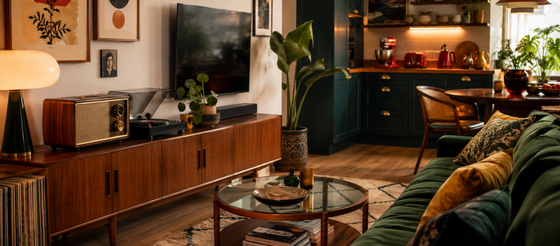
There was a time, not so long ago, when the “home of the future” was envisioned as a sterile, white-on-white laboratory. It was a world of hidden wires, touch-sensitive glass, and appliances that looked more like medical equipment than domestic companions. But walk into any stylish UK home in 2026, and you’ll find a very different story unfolding. The clinical minimalism that once dominated our Pinterest boards has been unceremoniously evicted, replaced by what design experts are calling “Eclectic Maximalism.”
For those of us in the electrical retail and trade sector, this isn’t just a shift in wallpaper choice. It is a fundamental pivot in how consumers view the hardware in their lives. Design is no longer a secondary consideration to be checked off after the spec sheet; for the modern consumer, design is the spec sheet. We are witnessing a “Retro Revival” that blends the warmth of the past with the intelligence of the future, and the opportunities for retailers are as vibrant as a cherry-red fridge.
Minimalism to Personality
The UK’s living rooms are currently undergoing a fascinating transformation. We are seeing a move away from the “buy it new, hide it away” mentality toward a more curated, character-rich aesthetic. The data tells a compelling story: the UK’s second-hand furniture market is on a trajectory to hit £1.1 billion by 2027. This represents a staggering 40.8% growth since 2022.
Why does this matter to the CE (Consumer Electronics) industry? Because the backdrop against which our products sit has changed. Consumers aren’t looking for a television or a speaker that blends into a white wall; they are looking for pieces that complement a “vintage maximalist” vibe, a search term that has spiked by 260% recently.
When a customer spends thousands on a mid-century sideboard or a refurbished 1970s velvet sofa, they don’t want a plastic-heavy, utilitarian piece of tech sitting on top of it. They want hardware that feels like furniture. This is the era of the “statement piece.” Retailers who understand this shift are no longer just selling gadgets; they are selling the finishing touch to an interior design dream.
Vinyl and Beyond
Nowhere is this nostalgia more evident than in the home entertainment sector. If you had told a tech analyst twenty years ago that in 2025, vinyl records would account for nearly 63% of all physical music sales, they would have laughed you out of the boardroom. And yet, here we are.
The UK vinyl market saw a massive 19.9% year-on-year increase in 2025, generating £174.7 million. This isn’t just a niche hobby for audiophiles anymore; it’s a mainstream cultural phenomenon. The tactile nature of physical media has returned with such force that even cassette tapes, a format many of us thought we’d left in the glovebox of a 1988 Ford Sierra, saw a 204.7% surge in early 2025.
But here is the most interesting part for the retail trade: 50% of people who bought a vinyl record in the UK last year did so as a collector’s or display item, without actually owning a record player. This highlights a critical insight: the aesthetic of the tech is often as valuable as its function.
However, for those who do want to listen, the demand for hardware is following suit. We’re seeing a boom in turntables and radios that look like they’ve been plucked from a 1950s diner but house high-fidelity internals. Take the radio market as a prime example. While analogue AM/FM listening has plummeted to 19%, DAB has become the titan of live radio, accounting for 48% of listening hours. The winning formula for retailers today is “Vintage Shell, Modern Soul” DAB radios with wood-grain finishes, tactile dials, and cloth speaker grilles that nonetheless offer seamless Bluetooth connectivity and crystal-clear digital reception.
The Kitchen Revamp
If the living room is the soul of the home, the kitchen is the heart, and currently, that heart is beating in full colour. For years, “safe” was synonymous with white or light grey cabinetry. Those days are over.
According to the latest Houzz UK Kitchen Trends Study, we are rapidly abandoning the clinical look. Grey still holds a lead at 21%, but blue (17%) and green (13%) are catching up fast. Interestingly, the UK has developed a particular love affair with green kitchens, leading the way in Europe. This shift toward deeper, more organic tones is creating a massive demand for appliances that can either contrast or complement these bold choices.
Enter the “Cherry Red” vibe. Identified as a major design trend for 2025 and 2026, this bold, retro-inspired shade is becoming the ultimate statement colour for small domestic appliances (SDAs). When a consumer invests in a kitchen renovation where the median spend has risen by 34% year-on-year, they aren’t looking for a £15 supermarket toaster. They are looking for the “cherry on top” of their £20,000 investment.
The SDA market is currently a powerhouse, valued at £2.8 billion in 2025 and forecast to hit £3.7 billion by 2030. This growth is being driven by design-led, multi-functional models. Consumers are looking for that perfect intersection of a retro silhouette, think rounded edges, chrome levers, and analogue temperature gauges and “smart” functionality.
The “Thrifty” High-End Consumer
One of the most surprising trends we’ve identified at Gekko is the rise of the second-hand kitchen. Much like the furniture market, there is a growing movement toward purchasing high-quality, pre-owned kitchen furniture. This is driven by a mix of sustainability concerns and a desire for “eclectic styling” that you simply can’t get from a flat-pack showroom.
For the electrical retailer, this presents a unique challenge and opportunity. A customer who has saved money by sourcing a high-end second-hand kitchen often has more “headroom” in their budget for premium, brand-new appliances. They want the vintage look of the cabinetry to be punctuated by the reliability and efficiency of modern technology. They are looking for the contrast of wood or laminate worktops (which hold a 14% market share) against the sleek, colourful pops of a retro-style kettle or a high-end range cooker.
Navigating the Retail Landscape
With 73% of UK consumers now choosing to purchase SDAs online to compare styles and prices, the role of the physical showroom has never been more vital or more pressured. To compete, the high street must lean into the “theatre” of the Retro Revival.
Online shopping is efficient, but it is rarely emotional. You cannot feel the weight of a chrome lever or see the way a “Cherry Red” finish catches the light on a digital screen. Retailers need to move away from “aisles of boxes” and toward “lifestyle vignettes.” Show the customer how that DAB radio looks on a mid-century sideboard; show them how the green cabinetry pops against a copper-trimmed toaster.
Final Thoughts
The “Retro Revival” is more than just a trend; it is a reaction. In an increasingly digital, intangible world, consumers are hungry for things they can touch, feel, and connect with. They want the reliability of 2026 technology, but they want it wrapped in the comfort and character of the past.
As we look toward 2027 and beyond, the winners in our industry will be those who recognise that we aren’t just selling “units.” We are selling the components of a home. Whether it’s a vinyl enthusiast looking for a deck that matches their “vintage maximalist” lounge, or a home cook looking for a stand mixer that serves as a piece of art on their green marble worktop, the message is clear:
Design isn’t just “everything”, it’s the only thing that makes a house feel like a home.
To read the full published article by Rupert Cook, Marketing Director, please visit ERT Magazine


