
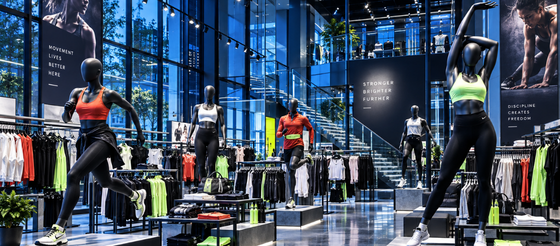
With social and online shopping taking a larger share of consumer spending, technology is increasingly becoming part of the retail experience and many well-known retailers are unable to maintain a competitive physical presence. It is undoubtedly becoming increasingly difficult, especially when overheads are increasing as they are. But despite many brands disappearing from Britain’s high streets, the appetite for pop-ups has never been stronger for many brands.
The significant growth in pop-ups and experiential retail goes hand in hand with rising digital competition. It is easy for online-only brands to get lost in the noise, but physical spaces offer a chance to stand out and reach new audiences. However, committing to a permanent retail location for some brands may be considered a risk, especially given rising costs, pop-ups offer the perfect cost effective alternative.
Pop-ups strike a balance: flexibility, visibility and engagement with lower overheads and far less risk. The appeal of pop-ups goes beyond cost and convenience. The most effective activations allow brands to create memorable experiences, gather valuable customer insight and build connections that last long after the doors close. They also offer flexibility on location, taking the experience regionally.
Experience as brand language
While physical stores continue to struggle in attracting shoppers, limited-time pop-ups that combine novelty with meaningful interactions can often draw consumers in droves. In fact, recent consumer research shows that 35% of UK shoppers visited a pop‑up store from an online brand and traveled to do so, making it a considered rather than impulse shopping trip.
While online shopping is a more transactional experience, a temporary space offers an opportunity for a two-way conversation between consumers and brands, immersing the consumer in the physical experience of the brand, rather than the familiar two dimensional digital experience the consumer has experienced up until this point. From the design of the space to the products and ‘wow’ moments, temporary environments become a platform for brand storytelling, with no limits and every element reinforcing the brand’s personality and values.
“The most effective activations combine creativity with commercial thinking, creating moments that are exciting and memorable for consumers while delivering insight and value for the brand.”
Daniel Todaro, CEO, Gekko Group
An in-person experience allows consumers to interact directly with a product, service or idea, creating a stronger emotional connection than a passive digital impression. This is particularly valuable for technology brands. As products become increasingly sophisticated, providing opportunities for hands-on interaction in a real-life environment can be a defining moment in the customer journey.
For those that offer services rather than tangible products, a pop-up can make innovation feel more accessible and relevant. The recent Gemini Nano Banana pop-up experience at Freight Island in Manchester, for example, allowed consumers to interact with the technology whilst at a lively World Cup screening venue, with a photobooth providing a tangible reminder of something that is otherwise incorporeal.
What is interesting about these experiences is not simply that they use new technology, but that the technology itself becomes part of the reason to visit. The physical environment provides a context in which consumers can experiment with something that might otherwise feel abstract or has been difficult to understand.
Pop-ups as retail intelligence
While raising awareness remains a key objective, pop-ups are increasingly being used as more than just marketing moments. They are becoming valuable testing environments for brands seeking to observe and understand their customers to make informed retail decisions.
Pop-up experiences allow brands to experiment with messaging and engagement, test new products and services, explore different approaches and do this in multiple locations, understanding better customer behaviour and gauge appetite for a more promotional or permanent physical presence. When planned with clear objectives, temporary spaces can provide real customer insight that can shape future campaigns, customer experiences and wider retail go to market strategies.
As well as gaining retail intelligence, brands can collect valuable customer data. In contrast to digital interactions, where consumers often part with their data begrudgingly in exchange for a discount, the memorable, one-off moments offered by pop-ups feel like a fairer trade. This makes consumers more receptive to ongoing communications – provided they are relevant, helpful and interesting – helping brands build new and stronger relationships based on mutual respect.
What makes a memorable pop-up?
While pop-ups can be an opportunity to sell products, when done well, go above and beyond. Gen Z and Millennials are 2–4 times more likely than Baby Boomers to visit a pop‑up, with 43% of younger shoppers citing a “unique or immersive experience” as a major draw, while exclusivity and limited‑edition items further increase the draw to the store, and increase footfall and buzz. Think about the choreographed lines that formed recently at Westfield for the various movie and make-up pop ups, offering unique and engaging experiences that go beyond the brand and offer tangible take-homes for visitors.
Online fashion brands such as ASOS have used temporary spaces to stage immersive events featuring curated fashion edits, brand collaborations and interactive activations. Access to limited-time exclusives and ‘you had to be there’ moments not only makes brands more memorable and helps consumers ‘put a face to the name’, but is also inherently more shareable.
One of the biggest advantages of experiential retail today is that the audience extends beyond those who attend in person. Consumers share their experiences online via social media, where views and engagement drive awareness and extend the lifespan and reach of an activation.
However, when activations are designed primarily around social content, they can often feel hollow or performative. The strongest experiences give people a genuine reason to engage, whether through exclusivity, interaction, entertainment or discovery. When a brand creates something worth experiencing, the social amplification follows naturally and never feels forced.
The most effective activations combine creativity with commercial thinking, creating moments that are exciting and memorable for consumers while delivering insight and value for the brand. They must have a clear purpose, firmly rooted in the brand’s wider objectives.
The future of temporary retail
The growing appetite for pop-ups certainly does not signal the end of permanent retail locations, but rather the maturation of the online market. Brands recognise that transactional interactions do not drive the differentiation and preference needed to cut through growing competition. Pop-ups are a popular solution because they can achieve multiple objectives simultaneously: they offer an opportunity to connect with consumers and raise awareness, while also providing vital insights needed to shape commercial direction.
As the landscape remains unpredictable, pop-ups offer appealing flexibility, allowing brands to test the zeitgeist and engage with consumers with a reduced element of risk or financial commitment associated with that of a permanent store. For some brands, pop-ups are merely a stepping stone towards a long-term physical presence – a way to assess viability. For others, pop-ups can often become a permanent part of their retail strategy, deployed as and when needed to support brand-building, acquisition or retention initiatives, and activated as and when needed, or when the time feels right.
To read the published article by Daniel Todaro, CEO, Gekko Group, please visit CreativeBrief

