
Tag Archives: content-marketing

TV Brand Building Through Sporting Sponsorship, is it a Golden Opportunity?

Brands are committing over £25.5 billion annually to European sports sponsorships as a strategic, long-term investment, which according to Nielsen, accounts for approximately 15% of a brand’s annual marketing budget. However, with an estimated 66% of consumers more likely to purchase from sponsoring companies Source, you can understand the reasoning behind such decisions and in particular for challenger brands looking to disrupt the market. 

For TV brands, major events like the Winter Olympics, which TCL is sponsoring through 2032 to gain ‘TOP’ tier prestige and challenge market leader Samsung, act as a catalyst for consumer electronics upgrades and bringing your brand into the consideration mix. Perhaps when your brand would have never registered with consumers without the mass exposure of say, the Winter Olympics, which is projected to have a global audience of 3 billion. 

Hisense, which has heavily invested in football sponsorships and in particular the FIFA World Cup, has seen itself rise to be the second-largest TV manufacturer by volume, yet its domestic market share recently dropped, highlighting the need for continuous activation and strategic evolution. 

Challenger brands such as Haier, who announced at IFA Berlin 25 their entry into the EU including the UK TV market, are positioning themselves with high-profile tennis sponsorships like the ATP Tour and Grand Slams such as the Australian and French Open. In doing so, they hope to target an affluent consumer electronics audience, as they aim to entice customers at the premium end of the TV market. Tennis sponsorship therefore suggests that a targeted, high end sports association is an effective strategy for Haier entering crowded premium markets such as the UK.

Why invest

It is estimated that the TV market in the UK was worth approximately £8bn in 2025 and forecasted to grow significantly to £20.8bn by 2035 – a 14% CAGR. This is clearly a robust growth forecast, which is driven in particular by technological advancements and changing consumer preferences. These include in the UK smart TV market, the premium TV segment, which continues to dominate sales and increases profitability for any brand. However the fastest-growing segment is the mid-range smart TVs, appealing to budget-conscious consumers, who, seeking advanced features, are more likely to invest in a challenger brand that’s new to the market. Integration with smart home devices helps sales further this is becoming increasingly popular with consumers as a way to enhance their in home user experience and connectivity – Source

Therefore the appeal for any challenger brand looking to establish itself in a new market is increasingly to align the brand with a major sporting event and that’s exactly what TCL and Hisense are doing as a way to take on the traditional brands such as LG, Samsung, Panasonic and Sony who have found value over volume a difficult challenge as their brands become for some, just more of the same at a higher price that they can’t justify any more.

While Samsung remained #1 (17% share) in the global market, TCL, the challenger brand you may have never heard of in the UK, up until now, reached a 16% share, placing it in a dead heat with the market leader. In contrast, Hisense’s share dropped to 10% in the same period, primarily due to a 24% decline in its Chinese home market shipments.

The Olympic pivot for TCL whilst Hisense owns the’”National Team Football’ space (FIFA and UEFA), has meant that TCL achieved a massive strategic move by becoming a Worldwide Olympic and Paralympic Partner through to 2032. This now propels TCL into the ‘TOP’ tier.  

Hisense has leaned heavily into the UK market, integrating the “Freely” IPTV service into its sets to win over local consumers but TCL owns its display panel manufacturing through CSOT. This allows TCL to protect its profit margins even when prices fall, whereas Hisense must negotiate for panels. This is further impacted by the clever move TCL recently made in taking control of Sony’s TV business operations in certain capacities, a move analysts believe will help TCL leapfrog Hisense in premium brand perception amongst both brands’ very similar target audience.

With both brands also aiming for Mini-LED dominance, they are now going head to head for the “Mini-LED” crown here in the UK and beyond. Hisense leads in ultra-large (100″+) sets with a 56.7% market share,however  TCL’s shipments of 75-inch and larger TVs surged by a whopping 138% in Europe during late 2025, this directly impacts Hisense’s most profitable segment which they rely on in the UK market.

TCL’s activation in Milano Cortina 2026 is moving beyond simple brand visibility to integrate its technology into the fan and athlete experience. Taking a leaf out of Samsung Mobile’s book with podium selfies, TCL are owning those precious ‘Athlete Moments’, providing connected stations at all competition venues, allowing athletes to share their experiences with family and friends. Combined with recruiting a roster of European ‘sporting ambassadors’ such as freestyle skier Eileen Gu as a Global Brand Ambassador, who appeal to younger, style-conscious audiences, athletic moments become more relevant through association with sporting heroes.

In addition to all this, TCL are also providing the digital displays for venues, technical support for the Olympic Broadcasting Services (OBS) centre, and equipping the Olympic Village with household appliances. TCL will play a key role in the IOC’s “Olympic AI Agenda,” supporting fan-facing AI experiences and real-time transcription and translation services for interviews. This partnership is clearly a move by the brand to challenge Samsung’s status as No.1. By securing the ‘Official Partner’ status that Samsung has now  held for 30 years, TCL is using the Olympics to close the remaining ‘prestige gap’ with its South Korean rivals. 

The customer journey

However, does any of it return an investment if you can’t find the product online or in-store and worse still, if those selling your devices aren’t able to pronounce or advocate for your brands as you’d like them to.

In the considered purchase space, creating credible messaging that translates easily and clearly to your target audience is a critical next step. More so when marketing a brand that perhaps isn’t completely familiar to all and remains a challenger in a very crowded and noisy market. Consideration from consumers includes justification in switching brands and even more so of a brand you may be buying into for the first time. Creating a customer journey that starts from a logo on a press wall, to a poster site campaign followed by TV and social engagement is costly to deliver and difficult to measure unless you have direct sales data that demonstrates the true impact and ROI of a brand’s investment.

Therefore, with the brand now front of mind cognitively and recognisable through Olympic association and complimentary advertising, how does a brand convert those shoppers, driven into store by your advertising efforts, into customers who buy into your brand at the point of purchase? With the brand recognition now established and the desire to buy into a new brand is greater than it may have been before amongst consumers, you’ve got the retailers ranging, the next stage is building a go to market marketing solution that builds on that awareness and plugs the sales gap. Without the knowledge on the shop floor, brand partnerships are never enough to bridge the knowledge gap and create significant change in sales out, not in. Investing in your retail partners through training and assisted sales is the next step on the brand’s journey and its future potential podium finish.

To read the published article by Daniel Todaro, Gekko Group CEO please visit ERT
Tagged , , , , , , , , , , , , , , , , , ,

The Digital Toolkit – Ai, Social Media and SEO for the Modern Retailer

For modern retailers, a robust digital presence is no longer optional; it’s essential for survival. Today’s digital landscape is complex, but by focusing on key strategies and leveraging the right tools, retailers can build strong customer relationships, boost brand visibility, and drive sales.

At its core, a good digital marketing strategy creates attractive online experiences that not only showcase products but also build trust and loyalty. It’s about meeting customers where they are, whether that’s on social media, in their email inboxes, or through search engines. This strategic approach allows even small and medium-sized retailers to compete with larger brands, extending their reach with a targeted message.

The Power of Social Media and Content

While many retailers are already on social media, the key to success isn’t just being present—it’s being effective. The importance of social media is clear, with global spending on social media advertising projected to reach approximately $276 billion in 2025 [Source: Talkwalker]. This highlights social media’s dominant position in the marketing landscape. Furthermore, a significant majority of consumers who have a positive interaction with a brand on social media are more likely to recommend that brand to their friends and family [Source: Synup].

However, what matters most is the content you create.

Content is King. This timeless phrase holds true now more than ever. Your content needs to be appealing, engaging, effective, and consistent. Whether you create it in-house or partner with the brands you stock, the goal is to captivate your audience and showcase your products in a way that feels authentic. For many small retailers, the challenge is having the time, budget, and creative skills to produce high-quality content.

Fortunately, modern AI tools have emerged as a real lifeline. What once took hours can now be done in minutes. AI can assist with everything from generating content ideas to writing compelling ad copy and even analysing campaign statistics. According to Talkwalker, 90% of businesses using generative AI report meaningful time savings, and 73% see tangible engagement rate lifts from AI-assisted content [Source: Talkwalker]. Tools like ChatGPT and Gemini are at the forefront of this revolution.

But AI doesn’t stop at text. Tools like Gemini’s Veo 3 & Lumen5 can create professional-quality videos from a few words of text, complete with voice-overs. If you want to reach a wider, multilingual audience, Sonix AI can translate your content and videos into different languages. This is a crucial strategy, as a majority of people prefer to learn about new products through short videos [Source: HubSpot].

The Unseen Hand of SEO

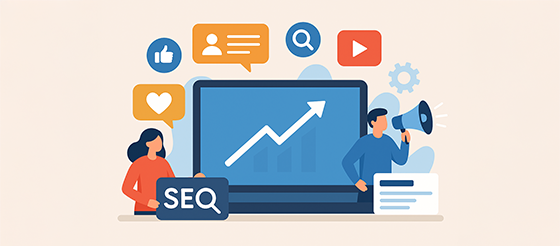
Another crucial, often overlooked tool is Search Engine Optimisation (SEO). In simple terms, SEO improves your website’s search engine rankings. It’s the difference between being on the all-important first page of Google or being lost on page ten.

The importance of SEO speaks for itself when you consider that 53% of all website traffic comes from organic searches [Source: WordStream]. SEO delivers a high return on investment (ROI), with some estimates suggesting a minimum ROI of 500% [Source: Improvado]. When compared to paid ads (PPC), SEO delivers a higher conversion rate, with some sources reporting that SEO converts at a rate of 2.4%, nearly double that of PPC’s 1.3% [Source: Sagapixel].

SEO involves a mix of strategies, including:

  • Use relevant keywords that your customers search for.
  • Create high-quality, valuable content that answers user questions.
  • Improve your site’s speed and user experience.

The goal of SEO is to increase organic (non-paid) traffic to your site, making it more visible to people who are actively looking for your products or services. A key benefit is its cost-effectiveness; many SEO tactics are free to implement. Simply ensuring your product pages include relevant keywords, such as “laptops” or “televisions,” for an electronics retailer can significantly increase the likelihood of your website appearing in search results.

Bringing It All Together

From AI for content generation to SEO for discoverability, retailers have a wide array of tools at their disposal. By strategically combining these techniques, mastering social media, embracing AI, and prioritising SEO, you can build a robust digital presence that not only attracts new customers but also keeps them coming back.

To read the published comment by Callum Puffett, Digital Marketing Manager, Gekko Group, please visit ERT

Tagged , , , , , , ,

Retail Reboot: Transforming Likes into Sales with Digital Marketing

Callum Puffett, Digital Marketing Manager at Gekko looks at some of the tools that can be utilised to help retailers of all sizes get a foothold on the Digital Marketing ladder to help improve their brand visibility and most importantly drive traffic. 

The Importance of Social Media

Today, digital retail marketing is crucial for brands to connect with customers. It means creating attractive online experiences that show products, build trust, and boost sales. It can encompass social media, search engines, emails, and online stores to, most importantly, help brands reach customers where they spend their time. In short, it’s an unavoidable tool for retailers looking to broaden their reach and communicate more effectively with their target audience, and crucially can greatly increase a retailer’s visibility and revenues.

Furthermore, a well-considered Digital marketing strategy allows small and medium-sized retailers to take on much larger competitors, even with limited resources. Small-budget retail marketers can conveniently promote their brand globally and reach consumers across the nation with ease.

Talking of small budgets, one of the easiest and cheapest gateways into digital marketing is social media. Social media channels can and should be used by almost every business, especially by ones wishing to talk to consumers, but their effectiveness varies depending on how they are utilised. Research conducted by LOCALiQ surveyed more than 500 businesses on the importance of certain tools; for Social Media Marketing the survey stated that 40.3% of businesses find it somewhat important with 46.6% indicating it is very important, indicating that the vast majority of businesses find it to be a very pivotal tool. This is also shown in their spending, as 31.3% of businesses will spend between £1,000 and £5,000 on social media advertising, with another 22% spending more​. These social media advocates appear to be most heavily invested in Facebook, allocating 24.4% of their budget to the platform, followed by X(16.4%) and Google (13.8%)​​.

In terms of the Return on Investment, when effectively utilising the tool it was shown that 73% of marketers find social media marketing to be cost-effective with the average ROI for social media ad campaigns being 250%​ according to (The Goat Agency)​​ (MarketingScoop)​.

Content is King

Most readers will no doubt be using social media as part of their marketing strategies and I’m not going to run through a list of the platforms available and their merits. But whatever opinions, statistics and case studies there are on social media marketing working for other businesses, these don’t help you make content that will sell your products or engage with your audience. Content is king and whether you choose to create it in-house, rely on the hopefully professional output of the brands you stock or a mix of both, making it appealing, engaging, effective and consistent is fundamental. Employing someone to manage this for you will make a real difference but that will come with a cost. Moreover, will they have all the creative and technical skills to create this content from scratch?

Rewind 5 years and the task could be overwhelmingly challenging. Fast forward back to the present and we now have a potential ally in the form of AI. You can now generate an idea into a finished product in 15 minutes with the help of AI. Businesses can now implement AI to assist them with their social media marketing, from creating content to writing copy to even analysing statistics. Need an Instagram post that talks to Gen Z or a LinkedIn post that is more B2B focussed? AI can very easily and rapidly adapt the approach and tone.

It can be a real lifeline for these smaller retailers that don’t have the budget of these bigger businesses. There’s a whole plethora of AI tools out there that will assist your business in the Social Media Marketing world and these can be cost-effective with many charging a reasonable monthly subscription. You will no doubt have heard of ChatGPT but there is a new kid on the block in the form of Gemini from Google that is currently being marketed on TV by the brand. 

Gemini in itself is very similar to ChatGPT but offers better integration with the whole Google Ecosystem, whether that’s their online office suite or on the latest Pixel phone, you’ll have your own AI assistant everywhere you go meaning there’s no reason not to be able to generate engaging captions or product descriptions for your business. But AI doesn’t stop there, there are all sorts of AI tools and assistants ranging from ones that will create professional quality videos from a few words such as Lumen5. This AI tool will also provide voice-over for your content to provide that extra impact. Want to appeal to your Welsh-speaking customers? How about using Sonix AI to translate all your content in a flash? No longer is it an arduous task to translate and produce content in multiple languages. 

The beauty of all of these tools is that they can be used in harmony, whether that’s using Google’s Gemini to come up with a script for a video, then using Lumen5 to create the video with a voice-over, and if you want to go that extra step further you could even use more AI tools to translate the video to another language to further your reach via Sonix. Then to finish it up you could even use the AI tool Pixlr to help create images to accompany your social media post. The possibilities are endless. 

Helping your content be found

One of the most overlooked tools at the disposal of digital marketers is SEO (Search Engine Optimisation), something most will have heard of but not necessarily fully understand.  SEO can be the difference between having a steady flow of traffic to your website or being a non-entity when it comes to internet search engines, relegating your business down from the all-important first page on the likes of Google or Bing. 

SEO in simple terms is the practice of enhancing a website so it ranks higher in search engine results. This involves using relevant keywords, creating quality content, improving site speed, and ensuring a good user experience. The goal is to increase organic (non-paid) traffic to the site by making it more visible to people searching for related information or services. The importance of SEO speaks for itself when compared to PPC (pay per-click) as SEO delivers a higher conversion rate (2.4%) compared to PPC ads (1.3%)​ (WPBeginner)​. 

Most SEO implementations can be free to do, making it the most cost-effective tool. The simplest way to begin this process is to ensure keywords for each page on the website are appropriate. E.g. if you’re selling televisions or laptops use these as keywords. This way when anyone searches online and uses one or more of the keywords you have attached to your website page the chances of your website appearing on the first page of results is significantly higher than without SEO Keywords.

From AI to SEO, retailers have a whole plethora of tools at their disposal to assist with a multitude of tasks whether that is generating content to appeal to your target audience with the help of AI tools or even helping your brand get discovered more easily through SEO. By harnessing the power of social media, AI and SEO, retailers can significantly enhance their digital presence and achieve substantial growth.

To read the published article written by Callum Puffett, Digital Marketing Manager please visit ERT Online

Photo from ERT Online

Tagged , , , , , , , , , , ,