
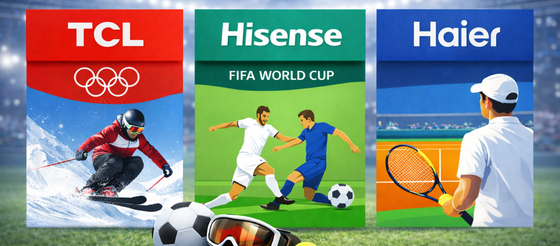
Brands are committing over £25.5 billion annually to European sports sponsorships as a strategic, long-term investment, which according to Nielsen, accounts for approximately 15% of a brand’s annual marketing budget. However, with an estimated 66% of consumers more likely to purchase from sponsoring companies Source, you can understand the reasoning behind such decisions and in particular for challenger brands looking to disrupt the market.
For TV brands, major events like the Winter Olympics, which TCL is sponsoring through 2032 to gain ‘TOP’ tier prestige and challenge market leader Samsung, act as a catalyst for consumer electronics upgrades and bringing your brand into the consideration mix. Perhaps when your brand would have never registered with consumers without the mass exposure of say, the Winter Olympics, which is projected to have a global audience of 3 billion.
Hisense, which has heavily invested in football sponsorships and in particular the FIFA World Cup, has seen itself rise to be the second-largest TV manufacturer by volume, yet its domestic market share recently dropped, highlighting the need for continuous activation and strategic evolution.
Challenger brands such as Haier, who announced at IFA Berlin 25 their entry into the EU including the UK TV market, are positioning themselves with high-profile tennis sponsorships like the ATP Tour and Grand Slams such as the Australian and French Open. In doing so, they hope to target an affluent consumer electronics audience, as they aim to entice customers at the premium end of the TV market. Tennis sponsorship therefore suggests that a targeted, high end sports association is an effective strategy for Haier entering crowded premium markets such as the UK.
Why invest
It is estimated that the TV market in the UK was worth approximately £8bn in 2025 and forecasted to grow significantly to £20.8bn by 2035 – a 14% CAGR. This is clearly a robust growth forecast, which is driven in particular by technological advancements and changing consumer preferences. These include in the UK smart TV market, the premium TV segment, which continues to dominate sales and increases profitability for any brand. However the fastest-growing segment is the mid-range smart TVs, appealing to budget-conscious consumers, who, seeking advanced features, are more likely to invest in a challenger brand that’s new to the market. Integration with smart home devices helps sales further this is becoming increasingly popular with consumers as a way to enhance their in home user experience and connectivity – Source
Therefore the appeal for any challenger brand looking to establish itself in a new market is increasingly to align the brand with a major sporting event and that’s exactly what TCL and Hisense are doing as a way to take on the traditional brands such as LG, Samsung, Panasonic and Sony who have found value over volume a difficult challenge as their brands become for some, just more of the same at a higher price that they can’t justify any more.
While Samsung remained #1 (17% share) in the global market, TCL, the challenger brand you may have never heard of in the UK, up until now, reached a 16% share, placing it in a dead heat with the market leader. In contrast, Hisense’s share dropped to 10% in the same period, primarily due to a 24% decline in its Chinese home market shipments.
The Olympic pivot for TCL whilst Hisense owns the’”National Team Football’ space (FIFA and UEFA), has meant that TCL achieved a massive strategic move by becoming a Worldwide Olympic and Paralympic Partner through to 2032. This now propels TCL into the ‘TOP’ tier.
Hisense has leaned heavily into the UK market, integrating the “Freely” IPTV service into its sets to win over local consumers but TCL owns its display panel manufacturing through CSOT. This allows TCL to protect its profit margins even when prices fall, whereas Hisense must negotiate for panels. This is further impacted by the clever move TCL recently made in taking control of Sony’s TV business operations in certain capacities, a move analysts believe will help TCL leapfrog Hisense in premium brand perception amongst both brands’ very similar target audience.
With both brands also aiming for Mini-LED dominance, they are now going head to head for the “Mini-LED” crown here in the UK and beyond. Hisense leads in ultra-large (100″+) sets with a 56.7% market share,however TCL’s shipments of 75-inch and larger TVs surged by a whopping 138% in Europe during late 2025, this directly impacts Hisense’s most profitable segment which they rely on in the UK market.
TCL’s activation in Milano Cortina 2026 is moving beyond simple brand visibility to integrate its technology into the fan and athlete experience. Taking a leaf out of Samsung Mobile’s book with podium selfies, TCL are owning those precious ‘Athlete Moments’, providing connected stations at all competition venues, allowing athletes to share their experiences with family and friends. Combined with recruiting a roster of European ‘sporting ambassadors’ such as freestyle skier Eileen Gu as a Global Brand Ambassador, who appeal to younger, style-conscious audiences, athletic moments become more relevant through association with sporting heroes.
In addition to all this, TCL are also providing the digital displays for venues, technical support for the Olympic Broadcasting Services (OBS) centre, and equipping the Olympic Village with household appliances. TCL will play a key role in the IOC’s “Olympic AI Agenda,” supporting fan-facing AI experiences and real-time transcription and translation services for interviews. This partnership is clearly a move by the brand to challenge Samsung’s status as No.1. By securing the ‘Official Partner’ status that Samsung has now held for 30 years, TCL is using the Olympics to close the remaining ‘prestige gap’ with its South Korean rivals.
The customer journey
However, does any of it return an investment if you can’t find the product online or in-store and worse still, if those selling your devices aren’t able to pronounce or advocate for your brands as you’d like them to.
In the considered purchase space, creating credible messaging that translates easily and clearly to your target audience is a critical next step. More so when marketing a brand that perhaps isn’t completely familiar to all and remains a challenger in a very crowded and noisy market. Consideration from consumers includes justification in switching brands and even more so of a brand you may be buying into for the first time. Creating a customer journey that starts from a logo on a press wall, to a poster site campaign followed by TV and social engagement is costly to deliver and difficult to measure unless you have direct sales data that demonstrates the true impact and ROI of a brand’s investment.
Therefore, with the brand now front of mind cognitively and recognisable through Olympic association and complimentary advertising, how does a brand convert those shoppers, driven into store by your advertising efforts, into customers who buy into your brand at the point of purchase? With the brand recognition now established and the desire to buy into a new brand is greater than it may have been before amongst consumers, you’ve got the retailers ranging, the next stage is building a go to market marketing solution that builds on that awareness and plugs the sales gap. Without the knowledge on the shop floor, brand partnerships are never enough to bridge the knowledge gap and create significant change in sales out, not in. Investing in your retail partners through training and assisted sales is the next step on the brand’s journey and its future potential podium finish.
To read the published article by Daniel Todaro, Gekko Group CEO please visit ERT
 gekkofm