Tag Archives: Gekko

Rebuilding that Emotional Connection with Your Consumers

emotional connection banner

With declining food sales mirroring the retailer’s fashion decline, it has appeared that Marks and Spencer, under the reign of Marc Bolland, has been spinning into terminal decline. But hang on. Our much loved M&S where, with little exception, we have either worn or eaten their wares over the decades, has suddenly bounced back with a vengeance. The launch of a new food campaign set to an instrumental version of the Clean Bandit track Rather Be has succeeded where recent fashion ads have failed – driving an emotional connection with those consumers who have fallen out of love with its style, format and quality. Capitalising on food’s current status of being on trend, the retailer has returned to a less cheesy format than recent advertising using a “go on, try me” kind of approach has done in the past. In my opinion, this will go some way in helping to rebuild the emotional connection with disaffected M&S shoppers, tempting them to return in-store and try a treat or two again.


Its fashion ATL has also wisely taken a change in tact, ditching the leading ladies in favour of a simpler execution with the Ed Sheeran track Sing, designed to strike a chord with everyday customers, who aren’t impressed or swayed by celebrity endorsement. The clothes or food might not be to everyone’s taste or appeal to a specific age group, but this ATL campaign brings back the emotion this much loved UK brand badly needs to reconnect with their customers and compete with the other household brands. I am impressed and genuinely like this approach. This may just work and evolve into a spectacular Christmas ATL campaign re-establishing the M&S brand.


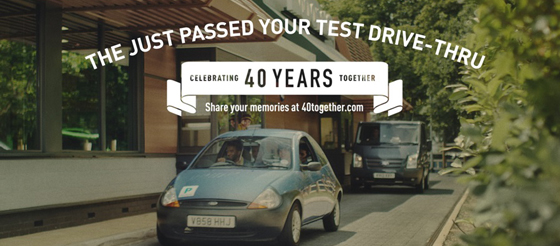
Another long standing representative on the British high street, McDonald’s, seems to be succeeding in re-marketing themselves to a wider, more health conscious audience. Considered by many the antipathy of healthy eating, even perhaps the pariah of fast food only one step up from the generic chicken shop, McDonald’s sat closely with its counterparts Burger King and KFC, with very little to distinguish them apart – until now. Their new ATL is taking a step back in time, reminding us how great we thought McDonald’s used to be, how much of a treat it was and the special occasions that we had long forgotten during which we chose to feast on McDonald’s. Roll up the new look and feel of McDonald’s, at least portrayed by its advertising, that will entice some of us to go back and revisit that memory of our first McDonald’s. Perhaps even make a child’s first experience of McDonald’s a seminal moment like it was for us, rather than what it has perhaps become as a soiled moment tinged with guilt. Maybe we should all be a bit more carefree, a little bit of what you like as a treat on occasion is alright.


Read more at: http://www.brandingmagazine.com/2014/10/06/rebuilding-that-emotional-connection-with-your-consumers/

Tagged , , ,

Gekko add another two awards to their collection

lle banner awards

Over the past month, Gekko has added another two awards to their collection with a win at the IPM COGS Awards in the Best Experiential category, and a highly commended in the Creative Industries category at the London Loves Excellence Awards.

At the COGS Awards, Gekko’s ‘Down by the Lilypad’ campaign for Freeview impressed the judges with its creativity, effectiveness in communicating Freeview’s brand message, and impressive results.

The Institute of Promotional Marketing hold the COGS Awards each year to recognise and reward the achievements and successes of the UK’s marketing service providers.

10155412_10152726033002065_2192618344161765064_n

Gekko was also highly praised at the London Loves Excellence Awards for its innovative approach to the channel, and for its clear consumer focus.

The London Loves Excellence Awards takes place each year to recognise talented individuals and organisations in the capital.

For the full list of COGS winners, please visit: http://www.theipm.org.uk/awards/the-ipm-cogs-2014.aspx

For the full list of London Loves Excellence winners, please visit: http://www.londonlovesexcellence.com/2014-winners

Tagged ,

Phones4U and the key role of partnerships

p4u banner

In the wake of the sad news about the unexpected downfall of Phones 4U which broke this week, it’s worth examining why and how responsible businesses can allow a profitable retailer to fail.

Over 500 of the retailer’s stores simply didn’t open on Monday, putting nearly 6,000 jobs at risk, and creating yet more holes in the high street. The news follows the sudden decision of major mobile phone operators to withdraw their products from its stores next year.

It’s a sad state of affairs, and highly unexpected given that Phones4U is a profit making company. From a business perspective, it’s not how business should behave.

Partnerships are vital to good business, offering the ability to pool resources, leverage creativity across companies, and boost the potential to thrive and make money.

There’s no question that they can sometimes be accompanied by calculated risk, but partnerships have the ability to change and evolve the market place and be a force for good, creating jobs, driving creativity and creating new products and services for consumers.

While Phones4U served all mobile carriers well when they needed them, and don’t forget this is a company which generated over £1bn in sales just last year, every brand/business relationship is a partnership of sorts, and partnerships are at risk of being squeezed by evolving business needs.

When one side of a partnership decides to take their business in a new direction, the creativity and enthusiasm at the core of the relationship is inevitably corrupted and broken up.

Naturally, as part of keeping partnerships fresh and forward-looking, procurement teams have to keep demonstrating the cost-efficiencies of the affiliation. However, a black and white focus purely on costs will stifle the potential for more creative ways the companies can work together.

The strongest partnerships aren’t consigned to the boardroom and procurement teams, they’re cultural partnerships too. The third party involvement of any brand has the ability to resonate with all aspects of a business. The involvement of brands can be used as an extension and facilitator of sales and marketing strategies, and enables the business to win new customers.

Ultimately, the term “partnership” is a convenient term used by both sides of any negotiation. This sad news from Phones4U demonstrates that in some instances it isn’t the right word at all.

Many of the news reports have highlighted the incredibly short notice Phones4U was given by its suppliers – not entirely the behaviour of “partners”. Of course, this is business. Both parties share a commercial agreement and must do everything in their power to protect their business from unforeseen circumstances, including a breakdown in any partnership if a brand behaves badly in order to benefit themselves.

That doesn’t stop it being a poor example for business across every industry.


Read more at: http://wallblog.co.uk/2014/09/15/phones4u-and-the-key-role-of-partnerships/

Tagged , , , ,

Wearable tech would benefit from an haute couture approach

apple watch banner

Figures from CCS Insight suggest that sales of smart wearable devices are going to rocket from 9.7m last year to 135m in 2018. This is predicted to include 68m smart watches and 50m smart bands. It’s not beyond the realms of possibility that the figures will prove accurate, though the claims don’t seem especially well-supported as there’s a lot that has to change between now and then if this massive boost in smart wearables is going to happen.

Primarily, the creators of smart wearable tech need to ensure they’re actively catering to a key market when it comes to setting trends, the fashion industry.

Consumers who are not only willing but able to spend £2k, £5k or £10k on a watch or an item of jewellery are the trendsetting future of wearable tech. If the fashion industry, and women in particular, are offered a wide range of high-end wearable tech in a variety of styles to choose from, the trend might really take off with all and not just those interested in tech. Yet at present many of these devices are for some aesthetically unappealing. If a consumer is offered a beautiful smart watch from an established luxury brand like Tag Heaur, Omega, Rolex etc, which has the desirability of a traditional high-end watch but with the extra functionality of a smart device, then perhaps wearable tech has a chance of really catching on as indicated.

It’s not unimaginable that eventually these high-end brands and fashion groups like LVMH will start having greater involvement in hardware, and not just the casing and accessories of smart tech. A Tiffany smart bracelet isn’t as far-fetched an idea as it might first seem. Once we reach a point where there’s a range of quality smart products to wear and match with what we’re wearing, how we’re feeling, or what we’re doing that day, then consumers will really get behind the idea. One day in the not too distant future it might be that someone going for a run puts on their hardy GPS smart wristband, before changing to go to a gig and putting on their more stylish smart watch. The possibilities of wearable tech are endless, but until the technology is more widely adopted by consumers, the tech giants and brands aren’t going to feel confident enough to invest in it.

Ultimately it may well take a greater push by Google with its Google Glass or a brand leader like Fitbit to get us to the tipping point where wearable tech is the norm. There are voices in the industry saying it’ll never take off because of privacy concerns; we must remember similar arguments were made when the internet was opened to mass consumer use. This is no time to be technologically impotent. The fact remains that with the phenomenal potential of wearable tech, demonstrated by Google Glass, to make our day-to-day lives more efficient and enjoyable, it is the future. It might take two or three years to truly establish itself, but the moment when mainstream and luxury brands fashion brands get on board with it, we’ll know the age of wearable tech has truly arrived.


Read more at – http://wallblog.co.uk/2014/08/20/wearable-tech-would-benefit-from-an-haute-couture-approach/

Tagged , ,

The REAL Ice Bucket Challenge

ice-bucket-challenge-cover

The ice bucket challenge has been a runaway success for charities. Social media has exploded with video content of nominated individuals showering themselves in icy water and nominating others to do it in the name of a good cause. And it has gone a long way to helping those causes. The Amyotrophic Lateral Sclerosis (ALS) Association, the instigators of the campaign, received over 36 times more in donations in August than they did over the same period the previous year ($98.2m versus $2.7m). The British equivalent, the Motor Neurone Disease Association, received nearly 14 times more (£2.7m) than usual (£200,000) in the last week of August. From a brand awareness perspective, and let’s face it charities operate as brands these days with everyone having “a” charity, it was astonishing. For very little investment the challenge generated over 28 million interactions on Facebook alone. Yet it has raised questions about the future of online charity campaigns, given the risks the ALS Association and others potentially opened themselves up to. Blog posts questioned the amount the ALS Association spends on salaries, Macmillan tried to hijack the challenge for their own cause, and there have been complaints in the Twittersphere that the campaign became about the vanity of nominees, not charity.

The campaign has raised the bar to incredible heights, highlighting what can be achieved on a small budget if one captures the imagination of the public. While it was all in aid of charity, it was all about social media. Thanks to Mark Zuckerberg, the campaign reached a dizzying number of people in a very, very short time. By having to nominate three people in every video, and many nominated more than that, it felt like watching the ‘six degrees of separation’ theory in action.

It reached a point where Facebook was so full of ice bucket videos that users felt normal service was suspended. Almost every post appeared to be a video of someone pouring cold water on their face. Despite the success of the campaign, it must have been unnerving to many to have to show off their generosity to charity in a very public video, rather than continue to quietly donate to the good causes they support. Those nominated had 24 hours to upload their video and nominate three others, which left those who – for whatever reason – didn’t want to make a video at risk of being stigmatised as uncaring spoilsports. Charities and brands have to be careful of leaving themselves open to association with behaviour that can potentially feel like bullying.

It’s also important that charities don’t get carried away. The ALS Association tried to trademark the term ‘ice bucket challenge’ which would have meant other charities would have had to pay them if they tried to run a similar campaign or event. This is a misstep for two reasons. It leaves a sour taste in our mouths when a charity tries to monopolize something people have been doing to raise money for months before the ALS Association co-opted it. And also, they’re mad to think they need the trademark. The ice bucket challenge will forever be associated with ALS for good and bad reasons. The real challenge for the Association, as a brand, is to ensure that the vast number of people who are now familiar with the acronym ‘ALS’ know about the condition. Converting social media show-offs into long-term donors and supporters of the cause is the real ice bucket challenge.


Read more at: http://www.brandingmagazine.com/2014/09/03/the-real-ice-bucket-challenge/

Tagged , , , , ,

The 55,492 dollar problem with Kickstarter

kickstart

Kickstarter made the headlines recently when a man crowd-sourced $55,492 from 6,911 backers to make batches of potato salad.

For a pledge of $1, the creator Zack Danger Brown, promised to say the ‘investor’s’ name out loud while he cooked the potato salad. For $5 they could add an ingredient to the potato salad and receive a bite. For $110, investors would get a recipe book, a shirt and hat and a bite of the potato salad.

It left many, me included, wondering how this project reached funding. To raise a bit of a laugh, fine, but this managed to raise over fifty thousand dollars of finance on what is supposed to be serious business funding platform, no?

Sure, it benefited from a parody video which went viral and subversive users on Reddit lapped it up too. Yet spare a thought for those on Kickstarter who could have got their business idea off the ground for a year or two on that money. These people could have grown their business, created jobs and brought wealth to the area they worked in. Instead we have kilo after kilo of potato salad being made for odd investors around the world.

It’s not the only time Kickstarter has been used as a punchline. Daily Show host Jon Stewart announced a couple of weeks ago that he’s launching a $10 billion fundraising campaign to buy CNN in order to keep it from being sold if Murdoch successfully buys Time Warner. In the end this satirical swipe at media giants only had a fake Kickstarter page set up. Yet the owners of the crowd-sourced fundraising website must be concerned that Kickstarter is being used as the butt of a joke about impossibly ambitious fundraising attempts. It makes Kickstarter look like a tool for pipe-dream business plans, not an environment for serious businesspeople.

Since the site was founded in 2009, it has raised over $1.5 billion for tens of thousands of projects. In these terms alone it must be looked at as a runaway success – but that’s a pretty shallow assessment of its value to business. The trouble with Kickstarter is that for all its successes, it can be viewed as a bit of a ‘get rich quick’ scheme.

A cynic wouldn’t accept Zack Danger Brown’s comments that he was only looking to raise $10. Offer Kickstarter users an empathetic, involving a story about why you’re raising money, and you’re as good as financed. The veracity of the people pitching isn’t properly looked at. It’s also arguably in Kickstarter’s best interests to keep these frivolous, inconsequential projects in the limelight. They make people laugh, raise awareness and further increase Kickstarter’s profits all-the-more.


Read more at: http://www.growthbusiness.co.uk/growing-a-business/business-finance/2469822/the-55492-dollar-problem-with-kickstarter.thtml

Tagged ,

Education is key for the connected home

connected home banner

The connected home, moving beyond the early adopter stage, is now trickling into the mainstream. Research we recently undertook highlighted that 17% of Brits would like and have no concerns about installing smart devices into their home. While on the other side of the pond a study by Accenture illustrates that 69% of consumers are planning to buy a connected home device in the next five years.

The entrance of the world’s biggest tech companies into the smart home market is likely to reassure consumers and accelerate adoption. Google’s £1.9 billion acquisition of Nest at the beginning of the year demonstrated its desire to be at the forefront of smart technology while Apple recently unveiled its HomeKit – a suite of tools for controlling home appliances.

However despite the growing appetite amongst consumers for ownership of smart devices, a great number remain unconvinced or cautious, with our research also revealing that an education job is needed on their use and set-up. Backing this up, just over a third of respondents also cited third party endorsements – whether through word of mouth or in-store advice – as the most important factor when researching a purchase. The stat highlighting the emphasis brands need to place on their in-store education experience. Furthermore, education is crucial for putting consumers’ minds at rest. Certainly an important thing to consider when 23 per cent of those interviewed were concerned with the complexity of setting up smart devices and a further 39 per cent were concerned that smart devices would be too intrusive or were worried that their data would be collected and used inappropriately.

What stood out for us from the research, is that human interaction and face-to-face communication is still hugely important in the purchasing journey. Brands therefore need to capitalise on this by developing their in-store strategies with specially trained in-store brand ambassadors. Yet they must also ensure their digital and in-store offerings are unified providing a seamless customer experience.

An example of major brands doing this effectively are Currys and PC World. They are rolling out ‘smart technology areas’ across their stores to help educate consumers and enable them to interact with connected appliances. Moreover they are investing in training their employees on smart technology and launching online microsites for customers which are dedicated to smart technologies.

Another industry where connected home devices are making a huge impact is the energy sector. With the soaring costs of utility bills securing significant recent media coverage, it is perhaps no surprise that smart thermostats to control a home’s heating are the most popular devices followed closely by lighting control systems. In a tight economy, where there is consumer desire to cut back on energy bills and with winter fast approaching, utility brands must start devoting more resources to marketing smart meters.

However as with all new technology it takes time for consumers to get on board and brands must support this journey by educating people on the products available and how they enhance your life by fitting in seamlessly or by accident. In my opinion, the ultimate winners of the connected home will come down to those who can provide a balance of security and privacy, whilst being reasonably priced with useful and intuitive functionality.


Read more at: http://wallblog.co.uk/2014/09/02/education-is-key-for-the-connected-home/

Tagged , , ,

Growth at Silicon Roundabout rivals Silicon Valley. How can we sustain it?

silicon-roundabout bannerHow can the UK tech scene overtake its rivals from across the pond?

It’s undeniable that London remains one of the most creative and diverse cities in the globe. This is evident in London’s Silicon Roundabout/Tech City which is arguably beating Berlin to be Europe’s number one, and ranked number three – against Network in New York and Silicon Valley in San Francisco – as the global ‘Tech Centre’.

This is certainly impressive and an achievement to be proud of. But then why, of the 30 $1bn tech companies created in Europe in the past 13 years, were only 11 of these companies were founded in the UK?

In comparison the US produced 39 such companies in the same period, according to research done by GP Bullhound.

European culture may make us more cautious when seeking expansion – but is this the reason why so many UK tech start-ups sell up too early to large US tech companies?

By doing so, they are making it easier for the US to lead the way, albeit only on paper.

It’s often argued that in the UK we have the best minds in the globe but we fail to incubate those great ideas, inventions and innovations.

Is this therefore the reason why there are only two UK registered tech firms listed on the FTSE 100?

Silicon Valley is well known as a haven for tech start-ups, and equally as the home of some of the world’s largest tech corporations. However, in recent years London has begun to outpace Silicon Valley and is now growing faster in terms of employee numbers.

This growth has allowed London to directly rival Silicon Valley by attracting global investment away from California.

Yet Silicon Valley start-ups on average still raise two to three times more capital in the early stages of their development in comparison to London.

Could this all change with Google’s venture capital arm and the opening of its Campus space in Shoreditch supplying office space and networking opportunities to UK start-ups?

It’s a great piece of US investment in the UK, rather unfortunately opened by George Osborne who hailed it as a centre for the European tech scene. This year it has already created 576 jobs with an average of £75,000 raised via formal sources by each start-up involved in the Campus.

It’s not a government initiative and certainly not a coup for the disastrous coalition. But whilst brilliant in every way, the Campus serves to drive London’s tech scene via a US company that cultivates start-ups before then relocating them to Silicon Valley to focus on the US market.

Instead, we should be cultivating and fostering that talent to make London and the UK the globe’s tech capital. We should be enticing US start-ups from across the pond to come here, rather than vice versa.


Read more at: http://www.londonlovesbusiness.com/business-news/tech/daniel-todaro-growth-at-silicon-roundabout-rivals-silicon-valley-how-can-we-sustain-it/8725.article

Tagged , ,

Smart homes lack consumer connection

connect home bannerDespite the hype around new tech concepts such as the ‘connected home’ and the ‘internet of things’, consumers are sceptical about the cost of the technology and the role it will play in their lives, new research suggests.

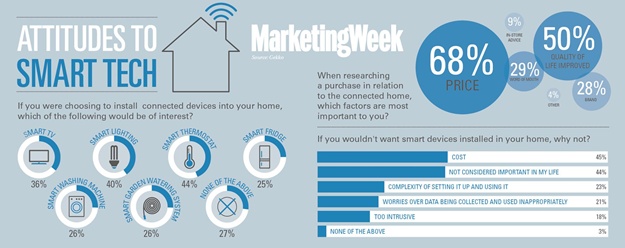
The study, seen exclusively by Marketing Week , reveals that over a quarter of respondents are not interested in having digitally connected smart appliances in their home. The survey of 2,000 UK-based adults, conducted by field marketing agency Gekko, also shows that most people are unwilling to pay more for connected devices.

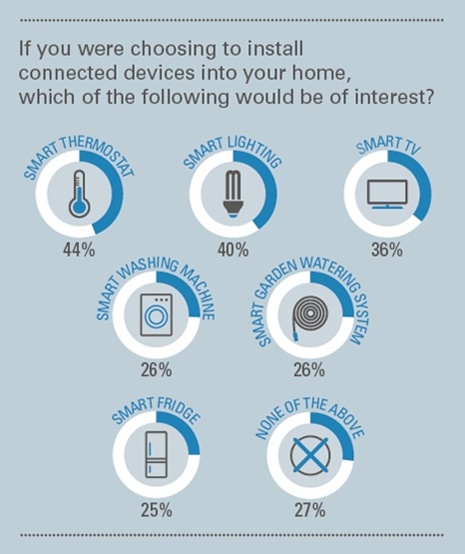
Among the appliances available, the smart thermostat is the most popular with 44 per cent of people saying they would consider installing one in their home. Smart lighting comes second (40 per cent) followed by smart TV (36 per cent).
which_connected_devices_are_of_interes_460
But 27 per cent would not consider installing a connected appliance, with 45 per cent citing cost as their top concern. When asked to specify an additional amount they would be willing to spend on such an appliance, the majority select zero.

Thirty per cent of people are willing to spend an extra £100 on a smart fridge that enables users to keep track of their food stocks via a mobile device. The majority (55 per cent), however, are unwilling to pay a premium for such an appliance.

Daniel Todaro, group managing director of Gekko, believes the concept of the connected home “has moved beyond the early adopter stage and started to trickle into the mainstream”. But given that many people remain unsure about smart appliances, brands must educate the public about the benefits of the technology, he says, adding: “Once people recognise the opportunities to save money, it will become more accessible.”

Todaro suggests that as the weather turns colder in the coming months and energy bills rise again, utility brands will devote more resources to marketing smart meters that enable people to control their heating remotely. In January, for example, British Gas ran a nationwide advertising campaign to promote its smartphone-controlled central heating system Hive .

According to the research, 50 per cent of people regard the impact on their quality of life as a key reason for buying a connected appliance, compared with just 28 per cent who care about the brand behind the product. Word of mouth matters to 30 per cent of respondents while 9 per cent regard in-store advice as an important factor.

what_factors_are_most_important_when_purchasing_a_smart_home_devic_460
Electronics retailers Currys and PC World are rolling out ‘smart technology areas’ across their stores to help educate consumers and enable them to interact with connected appliances. The companies are owned by parent group Dixons Carphone, which this month completed a £3.8bn merger that aims to put it at the forefront of the internet of things .

“We’re also investing in training our store colleagues on smart technology and launching online microsites for customers, which are dedicated to smart technologies such as connected home devices to help educate and inspire,” says Dave Ward, head of new technology and innovation at Currys and PC World. While the cost of installing smart appliances is relatively high, Ward claims prices are beginning to come down as the technology matures.

“We also think many of these technologies have the ability to save real money,” he adds. “Early adopters may pay a little more to be at the forefront but they will soon save money [on energy consumption] through devices such as smart thermostats and lights.”

In addition to the cost issue, 21 per cent of survey respondents express concern about how brands use personal data gathered from smart appliances. Eighteen per cent say the technology is ‘too intrusive’ while 23 per cent are concerned about the complexity of setting up the appliances.

Technology companies such as US firm Revolv have sought to simplify the connected home by creating a single hub through which all smart appliances are controlled. Revolv provides a router that receives signals from other companies’ appliances and a single app that allows users to co-ordinate all their home technology from their smartphone or tablet.

Last month the company launched an Android app to sit alongside its existing iOS offer and announced its integration with Google’s Nest thermostat. “Our brand promise is to unify off-the-shelf devices made by many manufacturers regardless of the protocol within those devices,” says Suttida Yang, director of marketing at Revolv.

With regard to the data issue the company is keen to ensure a strong value exchange with users. “We believe consumer data and privacy are owned by the consumer; there’s always a trade-off and convenience that we can provide when the consumer allows us to access that data,” says Yang. “To that end, we take privacy and security very seriously such that the communications between our app, hub and cloud are all encrypted and anonymised.”

The entrance of the world’s biggest tech companies into the smart home market is likely to reassure consumers and accelerate adoption. In June, for example, Apple unveiled HomeKit , a suite of tools for controlling home appliances. Apple is working with brands such as Honeywell, Philips and Broadcom to develop the platform.

why_do_you_not_want_smart_home_devices_in_your_hom_460
The $3.2bn (£1.9bn) acquisition of Nest in January demonstrates Google’s determination to be a dominant presence in the connected home too. Nest intuitively adjusts its settings according to people’s usage patterns, such as reducing the thermostat temperature setting when it senses nobody is home.

But despite excitement around these products, the role of connected devices depends also on government policy towards super-fast broadband. Last week, the UK Government said its plan to provide super-fast broadband to 95 per cent of homes and businesses by 2017 was “firmly on track” after announcing that one million homes and businesses have access already.

However, business lobbyists and commentators have criticised the Government for a lack of ambition, claiming that its definition of ‘super-fast’ lags behind many other nations. Gekko’s Todaro agrees with this assessment and believes stronger Government action is needed to support the growth of the internet of things across the UK.

“The Government is woefully behind on super-fast broadband,” he says. “Most homes in the UK don’t yet have the necessary speed of broadband to have a connected home.

“We’re way behind the Nordics, for example, and a lot of other places in Europe. It needs to become part of our psyche as a nation if we want to continue moving forward.”

3029290_Attitudes_to_smart_home_technology_infographic

Read more at – http://www.marketingweek.co.uk/trends/trending-topics/sector-trends/smart-homes-lack-consumer-connection/4011378.article

Tagged , ,

Wearable tech would benefit from an haute couture approach

glass fashion banner

Figures from CCS Insight suggest that sales of smart wearable devices are going to rocket from 9.7m last year to 135m in 2018. This is predicted to include 68m smart watches and 50m smart bands. It’s not beyond the realms of possibility that the figures will prove accurate, though the claims don’t seem especially well-supported as there’s a lot that has to change between now and then if this massive boost in smart wearables is going to happen.

Primarily, the creators of smart wearable tech need to ensure they’re actively catering to a key market when it comes to setting trends, the fashion industry.

Consumers who are not only willing but able to spend £2k, £5k or £10k on a watch or an item of jewellery are the trendsetting future of wearable tech. If the fashion industry, and women in particular, are offered a wide range of high-end wearable tech in a variety of styles to choose from, the trend might really take off with all and not just those interested in tech. Yet at present many of these devices are for some aesthetically unappealing. If a consumer is offered a beautiful smart watch from an established luxury brand like Tag Heaur, Omega, Rolex etc, which has the desirability of a traditional high-end watch but with the extra functionality of a smart device, then perhaps wearable tech has a chance of really catching on as indicated.

It’s not unimaginable that eventually these high-end brands and fashion groups like LVMH will start having greater involvement in hardware, and not just the casing and accessories of smart tech. A Tiffany smart bracelet isn’t as far-fetched an idea as it might first seem. Once we reach a point where there’s a range of quality smart products to wear and match with what we’re wearing, how we’re feeling, or what we’re doing that day, then consumers will really get behind the idea. One day in the not too distant future it might be that someone going for a run puts on their hardy GPS smart wristband, before changing to go to a gig and putting on their more stylish smart watch. The possibilities of wearable tech are endless, but until the technology is more widely adopted by consumers, the tech giants and brands aren’t going to feel confident enough to invest in it.

Ultimately it may well take a greater push by Google with its Google Glass or a brand leader like Fitbit to get us to the tipping point where wearable tech is the norm. There are voices in the industry saying it’ll never take off because of privacy concerns; we must remember similar arguments were made when the internet was opened to mass consumer use. This is no time to be technologically impotent. The fact remains that with the phenomenal potential of wearable tech, demonstrated by Google Glass, to make our day-to-day lives more efficient and enjoyable, it is the future. It might take two or three years to truly establish itself, but the moment when mainstream and luxury brands fashion brands get on board with it, we’ll know the age of wearable tech has truly arrived.


Read more at – http://wallblog.co.uk/2014/08/20/wearable-tech-would-benefit-from-an-haute-couture-approach/

Tagged , , ,