Author Archives: Gekko Marketing

The Brands Losing Their Cool Factor for the Sake of Profit


viv bannerRecently Apple has been widely scrutinised in the media, with many pundits accusing the tech giant of having lost its ‘cool factor,’ and hailing its recent acquisition of Beats as an attempt by the brand to get its mojo back. This couldn’t be further from the truth. It’s a cheap headlining trick that the media knows will grab attention. Sitting on top of Interbrand’s list of the world’s most valuable brands, Apple has managed to maintain its position as an aspirational brand without ever losing its cool factor. The brand is, and will continue to be cool; what other brand or retailer would inspire consumers to queue overnight in their masses for the launch of a new product? The Beats acquisition is a good fit for Apple; the two brands complement each other and, with Apple’s assistance, Beats will also continue to reign supreme.

However, for some brands the pursuit of global domination can come at a major cost:  The loss of their cool factor and aspirational quality. It’s interesting to note how far some brands will go to increase their profits at the expense of this intangible asset and how many have forfeited their coolness in the name of commercial success.

Take for example Innocent which started out as a small ethical start-up with an innovative idea:  Get your five a day in a tasty bottled smoothie. For years, the founders waxed lyrical about the importance of getting natural, healthy foods to more people; however, as soon as a conglomerate came along with an attractive offer, they were happy to sell out in a highly-publicised deal worth an estimated £100 million. The brand charged handsomely for what consumers essentially viewed as a fashionable and strangely aspirational fruit juice. Innocent’s association with Coca-Cola, and the subsequent dilution of its signature entrepreneurial spirit, has dented the brand’s cool reputation. The acquisition swiftly led to consumer concerns about the effect of Coca-Cola’s involvement in the business and the impact it would have on the brand’s values and personality. All of this has resulted in a dilution of brand identity and raised questions about the ethical values of Innocent. The launch of a new range of smoothies from Innocent coincidently will now showcase the effect the products have on drinkers rather than just highlighting their ingredients. However, what Innocent has perhaps missed is that consumers now choose alternate, less expensive fruit-based drinks in a declining market. The take-home smoothie sector decreased in value by 2.7 per cent year on year in 2012 and it has also suffered the loss of something less tangible:  It’s cool factor.

On another note, what we wear to some people is an extension of their personality and, in the case of the luxury market, fulfills aspiration. A brand currently losing in the cool stakes of the fashion sector is American footwear brand New Balance. Once worn almost exclusively by hipsters in Shoreditch and Bushwick alike, the appeal of New Balance has now expanded to a huge new mass market audience, most of whom would never previously have considered wearing the brand. New Balance trainers are no longer regarded as a trendy item and, with every celebrity from Heidi Klum to Rihanna spotted wearing them, the brand’s signature strapline, ‘Endorsed by No One’ is certainly no longer a reflection of reality. In fact, it was reported earlier this year that New Balance is now the second most popular footwear brand on Asos.com, just behind Nike. This loss of exclusivity only serves to switch off millennials who bought the brand for niche values. While New Balance couldn’t control the rapid increase in its appeal to a much larger audience, by entering, the brand has effectively lost its niche cool factor and joins the likes of Adidas and Puma in the mainstream fashion trainers category.

Finally, who is Vivienne Westwood’s customer? Westwood, once regarded as the enfant terrible of the fashion industry, managed to create something truly unique that didn’t appeal to a mainstream audience. Westwood is rightly recognised as a bastion of fashion and a UK icon. However, by over-licensing her products, her famous orb logo is now visible on garments throughout the country and has, as a result, lost some of its uniqueness. Furthermore, her new partnership with Virgin Atlantic which sees the Westwood brand designing the airline’s new uniform, should also be called into question. How can a luxury brand retain its appeal when your first class passengers, who may aspire to wearing Westwood, are wearing the same biased cut skirt as the air hostess serving them? While some brand partnerships, like that of Apple and Beats, seem to naturally complement one another, it’s fair to say that Vivienne Westwood and Virgin Atlantic is a stranger partnership. When you consider Westwood’s stance on the environment and her work as an ambassador for Greenpeace, is Virgin Atlantic really a good fit?

When approaching a new partnership or considering a different strategic direction, it’s important to take into account the impact it will have on your brand and its reputation. Follow Apple’s lead and strive for global domination, but make sure to stay true to the values that made your brand cool or aspirational in the first place and never forget the demographic who made you great. Yes, generations choose different brands as we evolve through life; however, a brand’s target demographic, whilst perhaps getting richer, never radically changes, but rather evolves.


Read more at: http://www.brandingmagazine.com/2014/07/04/the-brands-losing-their-cool-factor-for-the-sake-of-profit/

Tagged , ,

A view from Google Glass base camp

glass banner

After much speculation and hype, Google Glass has finally landed in the UK. Many have asked why, citing that it’s pointless and you won’t buy it. You will.

The ‘base camp’ event was held on the 27 and 28 June by Google in Kings Cross. I was reliably informed it was staffed by not only event staff but also Google employees working on Glass; which probably explained hearing “welcome to the future” one too many times. For those less gregarious amongst us, it was perhaps a bit intimidating, especially when you get to the photo demo and are asked to strike four poses wearing the Glass while they take photos. Many seemed keen, I wasn’t.

glass dan display

Following a brief tutorial wearing the new enhanced Glass with a flexible titanium frame, you get to learn the gestures whilst practicing not to squint, a natural reaction to something so alien but not necessary. Despite this, I couldn’t imagine wearing the Glass for a prolonged period.

Music, translation, star gazing were all on demo as were the different styles on display, which if I’m honest, whichever way you cut it, don’t look like normal glasses. I have no doubt however that these will change and get smaller, stylish and almost invisible like contact lenses.

What’s stunning about the device is its ease of use, clarity of vision, speed and endless possibilities. We’ve all read the scaremongering articles regarding the security or privacy aspects but putting that aside, this really is cutting edge technology that will change lives. Look at a sign in Italian and see it in English, look up at the sky and see the solar system geographically correct. I’m guessing we only experienced a minutia of what this product can really do but what we were allowed to try was impressive.

So will people buy and wear it? Are Brits going to shun this innovation as many have said? In my opinion, no, and avoiding any clichés, it is the future which will set the tech industry alive and move it to the next level.  This is a new category that changes everything, it’s the next step beyond your smartphone. Google the unassuming innovator has done it again.

Tagged , , ,

2014’s most successful World Cup campaigns

Risk everything blog copy

The Fifa World Cup has begun. Brands around the globe are in guerrilla marketing mode. Here are more highlights of the best unofficial campaigns from this year’s World Cup – with one exception perhaps.

Beats: #TheGameBeforeTheGame

‘The Game Before The Game’ is a beautifully executed campaign starring Luis Suarez, Robin Van Persie and an impressive roll call of other international footballers. Each of the athletes is shown during their pre-game rituals, with music revealed as a common theme. The viral advert has clearly touched a chord with a younger demographic who are responding positively on social media. Having hit the right tone for its target audience, this campaign will go a long way to reigniting the desire for Beats products that has perhaps waned in recent months. We can expect to see a global spike in sales for Beats in the coming weeks, just what the brand needs under new ownership.

Nike: ‘Winner Stays – Risk Everything’

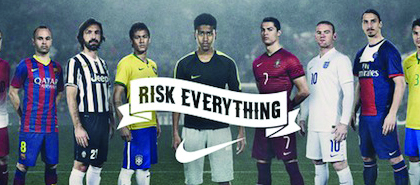
Nike’s unofficial World Cup advert has had more than 70 million views on YouTube and includes cameos from a whole host of prominent footballers including Cristiano Ronaldo, Neymar Jr, Wayne Rooney and Thiago Silva. The campaign coincides with the release of the brand’s latest football boot which features prominently throughout the advert. The activity cleverly combines a human touch of ‘backyard’ football with high-profile global superstars, without ever explicitly mentioning the World Cup. The campaign is proving to be significantly more prominent than ‘The Dream: all in or nothing’ advert from Adidas, an official sponsor of the World Cup. This effectively confirms Nike’s position as king of guerrilla ATL and the brand has once again scored big with high profile sportspeople and impressive levels of public engagement.

Carlsberg: ‘Fan Squad’

Another unofficial advert stealing the spotlight this year is Carlsberg’s ‘Fan Squad’ campaign. The spot portrays the perfect World Cup viewing conditions based on market research which asked fans what could ruin their experience while watching football at their local pub (e.g. size of the screen, queuing for drinks). Starring high-profile figures including Ian Wright, Paddy McGuinness and Jeff Stelling, the campaign focuses on their personalities and charisma rather than their star power. And by putting the match in the background and focusing on the collective experience in the pub, Carlsberg has successfully tapped into the shared experience quality of the World Cup. The advert is designed to position Carlsberg as the ‘beer of choice’ for England fans during the World Cup in a clear attempt to undercut Budweiser as the official beer of the tournament.

Visa: ‘Jamaica to Brazil: from athlete to footballer’

However, not all of this year’s official sponsors are being overlooked by their unofficial counterparts. Visa’s ‘Jamaica to Brazil from athlete to footballer’ campaign featuring global sprint legend Usain Bolt is possibly the most memorable piece of activity overall. The entertaining advert shows Bolt making his way from a Jamaican athletic track to the Maracana stadium in Brazil where he sneaks onto the pitch at the start of a match. Along the way the icon becomes immersed in Brazilian football, transforming from an athlete to a footballer with every online, contactless, and mobile purchase. The campaign is simple, clever, effective and memorable with huge brand recall; absolutely pitch perfect from the official World Cup sponsor.

Guerrilla marketing is becoming more and more sophisticated across all media, but now those official brands that have paid handsomely to be at the forefront of people’s minds will get four weeks of uninterrupted promotion. Their logos and messaging will be displayed across the electronic hoardings and on our screens during every match broadcast to a global audience of millions. That exposure, reinforced by any supporting ATL activity, will achieve the high brand recall desired by the sponsors; converting this into sales is the tricky part that brands must get right at the point of purchase to avoid guerrilla brands stealing too much of the market share.

Read more: http://wallblog.co.uk/2014/06/12/2014s-most-successful-world-cup-campaigns

Tagged , , ,

The toys of summer

Toys summer copy

Daniel Todaro, managing director at field marketing specialist Gekko, explains how electrical retailers can make the most of the upcoming summer of sport

With the 2014 Fifa World Cup kicking off on June 12, electrical retailers have a fantastic opportunity to leverage the excitement around the event and turn it into increased sales across their product portfolios.

Not only that, but with Wimbledon taking place during the tournament, and the Glasgow 2014 Commonwealth Games c0mmencing on July 23, we’re heading swiftly towards an accidental summer of sport.

Beyond the traditional football-themed, in-store competitions and promotional prices to attract customers in the lead-up to and during these events, what else can savvy electrical retailers do to increase footfall and ultimately drive sales during this exciting time of sport?

The World Cup is set to be broadcast on terrestrial television, which means that it will be available for everyone to watch. However, the time difference between Brazil and the UK may preclude younger viewers from watching the matches taking place later in the evening. This presents the perfect opportunity for retailers to promote sales of smart TVs and PVRs with catch-up services, so that fans can watch games broadcast late at night in the UK the next day at a more feasible hour. Electrical retailers should be promoting top-of-the-range devices with recording functionality like the Freeview HD + to exploit this golden opportunity.

To add to this, electrical retailers must capitalise on the fact that during the World Cup football fans will be looking to follow their teams on the widest screen possible to make themselves feel like they’re part of the action in Brazil, and create a party atmosphere in their homes.

In order to tap into this market, retailers should be promoting big screen-size television sales as the world gears up for the event. With GfK quoting that 60 per cent of global TV sales are over 40in and 36 per cent of those are smart TVs, there’s an opportunity for all. For the first time ever, certain games throughout the tournament, including the final, will be broadcast in 4K. Therefore, in the coming weeks and months consumers will be more open than ever to purchasing Ultra HD TVs, and it’s paramount that electrical retailers get those people through their doors to make these major purchases.

Here retailers should have in store brand ambassadors offering advice on the best devices and recommending 4K TVs, which globally are expected to top 10 million units in 2014 as forecasted by GfK.

However, these major sporting events are not just about TV sales and retailers shouldn’t underestimate the opportunity for incremental sales within other categories. For example, we can’t forget that the World Cup will also be broadcast on BBC Radio 5 Live, presenting football fans with an alternative way to follow their favourite teams. People around the UK will be listening on the road, in the garden, or simply while pottering around their homes. This presents another fantastic opportunity for electrical retailers to boost sales of high-end DAB digital radios and offer consumers the best listening experience possible supported by D-Love and the efforts of Digital Radio UK.

Finally, it’s important for retailers not to overlook another crucial market – people with absolutely no interest in sport. This sizeable group of consumers will also need to be entertained this summer, and they are the perfect group to target with catch-up devices. These devices offer the perfect opportunity for people to plan their own entertainment and to tune out the football chatter taking place all around them.

With four weeks of world-class football overlayed with Andy Murray’s bid to retain his Wimbledon title, followed rapidly by the Commonwealth Games, the opportunities for brands to get a piece of the action are endless. Historically we’ve seen a sharp increase in TV sales during the past three World Cup tournaments, and we can say with confidence that this is an opportunity not to be overlooked.

Read the article at: http://ertonline.co.uk/default.aspx.locid-05nnew3lh.Lang-EN.htm

Google, the unassuming innovator

Google logo blog

Since its beginnings in 1998, Google has transformed markets, business and social behaviour irrevocably for an entire generation. We are now programmed to ‘search’ before we do almost everything.

Google has developed beyond just being a search engine. It has created an ecosystem with the web browser as its backbone to become the modern day innovator with an array of much hyped tech products. Last week we saw Google Glass push the boundaries of technology with the example of the surgeon who became the first in the UK to use wearable tech during an operation. Next up is the Chromebook which is changing the dynamics and fortunes of the computing market.

The Chromebook is a laptop-shaped version of Google in every sense and is fast edging in on the traditional Microsoft PC and Apple Mac territory synonymous with remote computing with the support of high profile hardware vendors like Acer and Toshiba and chipsets from Intel.

Google is good at this. Chrome is without doubt becoming the internet browser of choice, superseding the likes of  Explorer, Firefox etc. Alongside this sits Google Maps, Images, Translate, Street view, Earth and YouTube – all Google businesses and applications that have become synonymous with a whole generation. Think vinyl to CD’s to MP3, our usage of internet based products and services are the only thing a generation has understood. And don’t forget Android, the mobile platform, which leads the global smartphone market. Unconsciously, people are affiliated with Google through Android – powered phones and therefore it is becoming part of the fabric of their lives. Google has become the unassuming innovator.

What is interesting about the Chromebook is that rather than trying to emulate the PC, its function has been developed in recognition of the most common use of a device – to interface with the internet, not work with the internet. It can’t help but shake up the PC market by creating its own category in the same way that streaming is overtaking DVD and BluRay.

There is no longer such a demand for an immobile desktop anymore and without doubt tablets are dominating sales, but many people still want to be able to do more than tap into apps. Latest figures from Canalys noted that tablets continued to outsell notebooks during the quarter, accounting for 41% of the market compared to 38%. There was a growth in PC sales of five per cent, while the tablet market saw 21% growth during the three month period up to March. This, however, is a significant decline from the 65% growth in the last quarter. Google is strident in its mission to flip what seems to be a flailing market upside down, offering everything you’d use a tablet for but offering more capability and with the convenience of a keyboard.

Chromebook is likely to build a loyal following, and, as Google has done with Android, the Chromebook is already naturally sliding into the line-up of traditional PC brands, suggesting that consumers will unconsciously become advocates of Google and the brand whilst still owning both a PC and a tablet.

Last week Google and Intel announced several new Chromebooks from Acer, Asus, Dell, Lenovo and Toshiba, acknowledging the opportunity Chromebook offers these brands as a category. Brand partnerships will continue to push Google’s brand to new consumers, as demonstrated by research firm NPD, Chrome OS computers accounted for 24% of sales of PCs under 300 dollars in the US over the first three months of the year. It has been predicted by market analyst Gartner that sales will reach 4.79 million worldwide in 2014 and for this appetite to rise by 66% next year.

Google is earning itself its seat on the world stage as a powerful global tech innovator. Far from resting on its laurels, the business continues to surprise and delight. Combine the giddy excitement in the face of their development of self-driving cars, with their CSR credentials in developing balloons carrying Internet access to developing countries  – and we have a brand that is quietly, and unashamedly changing the face of technology and how we interface with it, what’s not to love about Google.

Read the full article at: http://wallblog.co.uk/2014/06/02/google-the-unassuming-innovator/#ixzz33ZWfMXow

5 ways to motivate and retain staff (that might surprise you)

Image
I attended a Londonlovesbusiness.com roundtable event recently, and amid the debate were some interesting views on how best to attract and retain talent within technology, media and telecoms (aka, TMT).

Some attendees admitted a desire to move their businesses out of London – declaring its talent pool too costly and too shallow. And, yet, I would argue that London is home to some of the best talent in the UK – with more opportunity for employers to motivate and retain staff than anywhere else in the country.

Meanwhile there’s a growing trend among leading companies to use counter-intuitive methods to motivate and engage staff. Take Amazon, for example. Last month we saw the company launch a new programme where it offered its own employees thousands of pounds to leave the company – with the brand’s US CEO, Jeff Bezos, calling it a tactic to ensure they really wanted to work there.

This is just one recent example of how leading companies are using counter-intuitive methods to retain and motivate their staff.

Here are five other innovative methods to retain and attract top talent to your business.

1.Promote health and fitness
In today’s technology-obsessed world, it’s important to encourage employees to step away from their computers from time and time and focus on their health and well-being. Offer private sessions at the office with personal trainers, or even individual boot camps sessions during office hours. These methods, along with free gym memberships, are just the ticket to motivating and engaging employees.

Another way to engage staff is to arrange free one-on-one sessions with nutritionists who can provide advice on how to lead healthier lifestyles. And instead of treating the office with pizzas and pastries, why not offer healthier snacks that incorporate gluten-free and are lower fat?

2.Holidays and travel
Travel is a major appeal for lots of people. And offering the chance to board a plane and see some of the world is a great way to engage your staff with their work and your business.

You can do this by offering holidays for staff who hit targets, or by running company competitions with the chance to travel to an exotic location as the prize. In fact, the US software company, Full Contact, has gone so far as to pay its staff an extra £4,460 to take holidays.  And if the time isn’t taken? The employee doesn’t receive the money.

3.The Google Approach
In true Google fashion, the internet giant aims to strip away everything that gets in the way of its employees enjoying their work, and the brand’s package of fringe benefits is impressive. Each office around the world offers gyms, dry cleaning services and laundry rooms, haircuts, first-rate dining facilities and even carwashes.

As Google’s CEO Eric Schmitt put it: “Let’s face it, programmers want to program, they don’t want to do their laundry. So we make it easy for them to do both.”

4.Flexible working
It’s widely acknowledged that employees are motivated by flexible working hours. Talent can be retained and motivated by developing a culture where work fits around the personal lives of employees. Offering staff the chance to start late, finish early, change days, work from home, take time out to sing in a choir, work in a hospice, study and so on, is proven to have positive results when it comes to employee relations.

Flexible working not only motivates employees, but also offers them a chance to escape the stresses of the office and give something back to enrich their personal lives.

5.iPads and iPhones
Supplying employees with top of the range technology like iPads and iPhones helps keep all of those tech aficionados out there interested in your business. It also offers people the chance to keep in touch with their working environment, social media channels and news outlets. On a more practical level these gadgets allow employees the opportunity to interconnect their documents, take meeting notes and research at the touch of a button.


Read the full article at http://www.londonlovesbusiness.com/business-in-london/management/-5-ways-to-motivate-and-retain-staff-that-might-surprise-you/8128.article

The toys of summer

fifablog

With the 2014 Fifa World Cup kicking off on June 12, electrical retailers have a fantastic opportunity to leverage the excitement around the event and turn it into increased sales across their product portfolios.

Not only that, but with Wimbledon taking place during the tournament, and the Glasgow 2014 Commonwealth Games commencing on July 23, we’re heading swiftly towards an accidental summer of sport.

Beyond the traditional football-themed, in-store competitions and promotional prices to attract customers in the lead-up to and during these events, what else can savvy electrical retailers do to increase footfall and ultimately drive sales during this exciting time of sport?

The World Cup is set to be broadcast on terrestrial television, which means that it will be available for everyone to watch. However, the time difference between Brazil and the UK may preclude younger viewers from watching the matches taking place later in the evening. This presents the perfect opportunity for retailers to promote sales of smart TVs and PVRs with catch-up services, so that fans can watch games broadcast late at night in the UK the next day at a more feasible hour. Electrical retailers should be promoting top-of-the-range devices with recording functionality like the Freeview HD + to exploit this golden opportunity.

To add to this, electrical retailers must capitalise on the fact that during the World Cup football fans will be looking to follow their teams on the widest screen possible to make themselves feel like they’re part of the action in Brazil, and create a party atmosphere in their homes.

In order to tap into this market, retailers should be promoting big screen-size television sales as the world gears up for the event. With GfK quoting that 60 per cent of global TV sales are over 40in and 36 per cent of those are smart TVs, there’s an opportunity for all. For the first time ever, certain games throughout the tournament, including the final, will be broadcast in 4K. Therefore, in the coming weeks and months consumers will be more open than ever to purchasing Ultra HD TVs, and it’s paramount that electrical retailers get those people through their doors to make these major purchases.

Here retailers should have in store brand ambassadors offering advice on the best devices and recommending 4K TVs, which globally are expected to top 10 million units in 2014 as forecasted by GfK.

However, these major sporting events are not just about TV sales and retailers shouldn’t underestimate the opportunity for incremental sales within other categories. For example, we can’t forget that the World Cup will also be broadcast on BBC Radio 5 Live, presenting football fans with an alternative way to follow their favourite teams. People around the UK will be listening on the road, in the garden, or simply while pottering around their homes. This presents another fantastic opportunity for electrical retailers to boost sales of high-end DAB digital radios and offer consumers the best listening experience possible supported by D-Love and the efforts of Digital Radio UK.

Finally, it’s important for retailers not to overlook another crucial market – people with absolutely no interest in sport. This sizeable group of consumers will also need to be entertained this summer, and they are the perfect group to target with catch-up devices. These devices offer the perfect opportunity for people to plan their own entertainment and to tune out the football chatter taking place all around them.

With four weeks of world-class football overlayed with Andy Murray’s bid to retain his Wimbledon title, followed rapidly by the Commonwealth Games, the opportunities for brands to get a piece of the action are endless. Historically we’ve seen a sharp increase in TV sales during the past three World Cup tournaments, and we can say with confidence that this is an opportunity not to be overlooked.

Read the full article at http://ertonline.co.uk/Default.aspx.LocID-05nnew3lh.RefLocID-05n03s004.Lang-EN.htm

What Will Ever Become of VAIO?

Image

Ever since Sony’s announcement in early February to divest the VAIO brand, we’ve not heard much. Created in 1996, it became a global brand with that famous analogue wave and digital symbolism, creating a globally recognised logo that overcame language barriers. So what next for VAIO?

The brand in the UK seems unloved, stock-filling the channel at high end prices for low spec, and it would appear, with virtually no marketing support from Sony. Are we seeing the dying embers of the VAIO brand being packaged up to be sold to the highest bidder, or the self-destruction of a very youthful, global brand?

Whilst technology usage habits have changed, I think it’s fair to say that VAIO didn’t meet the demands of consumers. A poor tablet proposition and equally poor build quality and cut through in that very important corporate space has meant that VAIO has not moved ahead, or indeed along, with the current times. Like every PC manufacturer must, making significant inroads in B2B to support the consumer market is crucial in order to drive brand equity through cleverly designed and attractive products which create desire, need and want appeal with everyone. Google’s minimalist Chromebook is testament to this and OEM support from industry leading brands Acer, HP and Toshiba will serve to benefit these brands alike. But not being able to bring a viable VAIO tablet to market is disheartening for such a massive brand. Worldwide sales of tablets to end users reached 195.4 million units in 2013, a 68 per cent increase on 2012, according to Gartner, Inc. The demand for tablets is palpable and growing.

The tablet market has become a challenging environment for branded hardware-driven players. In 2013, Microsoft’s tablet volumes improved but share remained small. Despite Microsoft now acting more rapidly to evolve Windows 8.1, its ecosystem still failed to capture major consumers’ interests on tablets. Samsung exhibited the highest growth of the worldwide tablet vendors, at 336 per cent, in 2013. With Apple having just announced its second quarter figures stating that every 2 in 3 iPads purchased were done so by new users and forecasting that tablet users will overtake PC numbers in the coming years, perhaps we can see why Sony is selling its PC business and the potential loss of a successful brand in the market.

With EE announcing the abandonment of one of the globe’s most recognised and respected brands in the UK since 1994 that is Orange, in favour of the infant EE brand, are we seeing those technology brands of the nineties expiring as they no longer speak to an audience 20 years on?

I suspect the VAIO and Orange brands won’t disappear from the market. After all, France Telecom has just rebranded all of its European telecom business to Orange. Maybe the introduction to new and fresh markets will see VAIO thrive where it seems to have failed to create new markets for itself. No doubt VAIO will live another day, but why build a brand to then abandon it? Confidence and zeal to survive must be innate in a brand to give it the tools it needs to innovate and be considered in the mix by consumers in a crowded, style and brand conscious “digital” marketplace.

Read the full article at http://www.brandingmagazine.com/2014/05/05/what-will-ever-become-of-vaio/

Will Google Glass arrive at retail or is it just a beautiful PR stunt?

Image

We simply cannot escape talk around Google Glass. It’s as ubiquitous as the Beckham’s and their PR allure. Ever since Google Glass hit the media, I feel like it’s an established and viable product as modelled by the curly-haired model in the original promotional photo, which the media are still using.

But despite years of buzz, the consumer is still no closer to adding the glasses to their ever-expanding tech kit. So is Google Glass just a clever PR stunt that refuses to give up, or are we set to see the product reach the hands of those who matter, the consumer?

Google Glass seems to have been everywhere but the shop shelves. Diane von Furstenberg used the product on the catwalk at New York Fashion Week, while Virgin Atlantic has tied up with the brand for flight crew to check in passengers on selected trans-Atlantic flights.

Brands want to build partnerships with this newsworthy, futuristic piece of innovation and why wouldn’t they when Google Glass is experiencing a media frenzy? It’s exposure on a scale any business desires, singling out its brand through association as the future now.

But no one has had more positive brand awareness than Google itself, which is why this could all be a bubble about to burst. There are many barriers the brand has to overcome before it’s ready for public consumption.

It is heavily tested and commented on by the BBC’s Technology Correspondent Rory Cellan-Jones, who states: “So far, I’m intrigued by the possibilities that Glass offers, but not convinced that the user interface is up to scratch.”

Doubt clouds Glass sceptics as to the viability of the product in the face of increasing privacy rules and pressure on Google to respect these rules. Even in preliminary testing phases, Google Glass has opened a Pandora’s Box of legal concerns. If it does become the next big thing in wearable technology, what are the ramifications for intellectual property and personal privacy when somebody can secretly film or take a picture of you with, literally, the wink of an eye?

It’s now standard practice to see all manner of things documented online by people when using one hand with a mobile phone; what will happen when they are given glasses that make it possible for them to be recorded with two hands? Google responded by making modifications that would make this harder to do, but hackers will be only too happy to quickly find ways around those measures.

A report out highlights the fears consumers have over privacy issues pertaining to the product. It was found that 72 per cent of Americans cited privacy concerns as the biggest reason for not wanting to wear Glass. Those polled were especially concerned about the possibility of hackers accessing personal data and revealing personal information, including location information, Adweek reported.

That’s not to say I don’t applaud Google for this extravagant teaser campaign. It’s been executed extraordinarily well and it has built up a buzz and anticipation that may explode into fireworks or a flame, leaving us wanting more, but when’s the launch date?

If it does indeed arrive into the retail space, I can only imagine it will be a watered down variant of the present. But the fact that Ray-Ban sunglasses maker Luxottica announced last month that it has sealed a strategic partnership with Google over its Glass eyewear surely only adds fuel to the fire of concerns over privacy intrusion.

Imagine sitting on a train opposite someone who appears to be wearing a regular pair of Ray Bans, when really they’re analysing your data – it’s just not acceptable in a democratic society. Or has democracy gone full circle where the insistence on knowing everything has now come to threaten our right to privacy?

Nonetheless, this innovation, in which ever form it manifests itself, will eventually land in a retailer near you (I hope) and it will need investment in dedicated, knowledgeable brand representatives who can create the right consumer engagement with those cost conscious shopper tribes. This must be a priority if they are to make a connection with consumers and help them understand how this innovation works to enhance their day-to-day lives, to leave them with a memorable impression of both the product that will lead to a sale.

Whether Google Glass comes into the retail space or not, one thing is for sure: this has been an unstoppable PR masterpiece.

Read the full article at http://www.pcr-online.biz/news/read/blog-will-google-glass-arrive-at-retail-or-is-it-just-a-beautiful-pr-stunt/033797

Tagged , , , ,

The state we’re in

Image
As the industry awaits a decision about the proposed £4 bn Carphone Warehouse/Dixons merger, which would effectively see one retailer gain a monopoly in the market, it seems an appropriate moment to reflect on the state of the electrical retailing industry.

Expenditure in the electronics industry is set to increase in 2014. Last week saw Vodafone announce that it is to create 1,400 jobs across the UK by opening 150 stores in 2014, an impressive feat against a challenging economic backdrop.

This is in sharp contrast to developments on London’s Tottenham Court Road, once regarded as the place to go for any kind of electronics, where we’re seeing so many major brand stores closing their doors.

Did these brands put enough into offering every customer the best possible shopping experience? It could be argued that for these retailers the importance of creating an appealing shopping experience was forgotten.

Developments on Tottenham Court Road highlight the importance of treating every consumer that enters a store as a potential customer.

This especially hits home when the costs involved in marketing campaigns to attract that potential customer are considered, along with the major overheads needed to keep stores open.

According to research commissioned by Gekko earlier this year, 53 per cent of UK consumers regard electronics as investment purchases, with almost 20 per cent buying electronic products due to brand status.

The research also found that 53 per cent of UK shoppers do their research online before making a purchase in-store.

With so many consumers dedicating time to online research, it’s vital that retail brands provide an appealing digital experience and keep their website serviced with the most up-to-date information about their products.

The research also found that for high-ticket electrical items, 53 per cent of consumers want to touch, feel and experience the product to ensure that they are getting value for money in their purchase.

In order to attract shoppers to their stores, retailers must ensure that the in-store experience runs seamlessly alongside the shopping experience online.

When consumers walk through the door, the branding, feel and format of the store must feel familiar to the consumer.

A positive consumer experience helps to drive the value for money criteria by making consumers feel special, added to by attentive staff that aren’t pushy, but know how to sell based on the needs of the customer.

The shop floor must be ready for different shoppers, for whom value means different things. Understanding the shopper will help to open up the right channels engagement for the brand.

Every major electrical brand out there wants to appeal to the broadest demographic possible, and most businesses will spend vast sums of money in order to achieve this goal.

However, when a brand is sold through a third party retailer, the brand has less control, and this is where the vital role of field marketers comes to the fore.

It’s crucial for electrical goods retailers to have brand ambassadors in third party stores who understand their brand, how to achieve the connection sale and are equipped with the knowledge and training to provide impartial and factual advice about the benefits of their products.

This human element is vital; it is the reason many customers will visit the stores, to have a two-way conversation with an expert and receive guidance in making a decision is key to driving sales.

Field marketing plays an important element in making the customer journey more controlled and profitable for brands.

With all of the closures on Tottenham Court Road, it’s easy to assume that while still being sold via a third party store, brands had a lot of control over the customer journey.

The importance of an appealing brand and shopping experience which engages the consumer both online and offline cannot be underestimated.


Read the full article at: http://ertonline.co.uk/Default.aspx.LocID-05nnew3lf.RefLocID-05n03s004.Lang-EN.htm