Author Archives: Gekko Marketing

Education is key for the connected home

connected home banner

The connected home, moving beyond the early adopter stage, is now trickling into the mainstream. Research we recently undertook highlighted that 17% of Brits would like and have no concerns about installing smart devices into their home. While on the other side of the pond a study by Accenture illustrates that 69% of consumers are planning to buy a connected home device in the next five years.

The entrance of the world’s biggest tech companies into the smart home market is likely to reassure consumers and accelerate adoption. Google’s £1.9 billion acquisition of Nest at the beginning of the year demonstrated its desire to be at the forefront of smart technology while Apple recently unveiled its HomeKit – a suite of tools for controlling home appliances.

However despite the growing appetite amongst consumers for ownership of smart devices, a great number remain unconvinced or cautious, with our research also revealing that an education job is needed on their use and set-up. Backing this up, just over a third of respondents also cited third party endorsements – whether through word of mouth or in-store advice – as the most important factor when researching a purchase. The stat highlighting the emphasis brands need to place on their in-store education experience. Furthermore, education is crucial for putting consumers’ minds at rest. Certainly an important thing to consider when 23 per cent of those interviewed were concerned with the complexity of setting up smart devices and a further 39 per cent were concerned that smart devices would be too intrusive or were worried that their data would be collected and used inappropriately.

What stood out for us from the research, is that human interaction and face-to-face communication is still hugely important in the purchasing journey. Brands therefore need to capitalise on this by developing their in-store strategies with specially trained in-store brand ambassadors. Yet they must also ensure their digital and in-store offerings are unified providing a seamless customer experience.

An example of major brands doing this effectively are Currys and PC World. They are rolling out ‘smart technology areas’ across their stores to help educate consumers and enable them to interact with connected appliances. Moreover they are investing in training their employees on smart technology and launching online microsites for customers which are dedicated to smart technologies.

Another industry where connected home devices are making a huge impact is the energy sector. With the soaring costs of utility bills securing significant recent media coverage, it is perhaps no surprise that smart thermostats to control a home’s heating are the most popular devices followed closely by lighting control systems. In a tight economy, where there is consumer desire to cut back on energy bills and with winter fast approaching, utility brands must start devoting more resources to marketing smart meters.

However as with all new technology it takes time for consumers to get on board and brands must support this journey by educating people on the products available and how they enhance your life by fitting in seamlessly or by accident. In my opinion, the ultimate winners of the connected home will come down to those who can provide a balance of security and privacy, whilst being reasonably priced with useful and intuitive functionality.


Read more at: http://wallblog.co.uk/2014/09/02/education-is-key-for-the-connected-home/

Tagged , , ,

Growth at Silicon Roundabout rivals Silicon Valley. How can we sustain it?

silicon-roundabout bannerHow can the UK tech scene overtake its rivals from across the pond?

It’s undeniable that London remains one of the most creative and diverse cities in the globe. This is evident in London’s Silicon Roundabout/Tech City which is arguably beating Berlin to be Europe’s number one, and ranked number three – against Network in New York and Silicon Valley in San Francisco – as the global ‘Tech Centre’.

This is certainly impressive and an achievement to be proud of. But then why, of the 30 $1bn tech companies created in Europe in the past 13 years, were only 11 of these companies were founded in the UK?

In comparison the US produced 39 such companies in the same period, according to research done by GP Bullhound.

European culture may make us more cautious when seeking expansion – but is this the reason why so many UK tech start-ups sell up too early to large US tech companies?

By doing so, they are making it easier for the US to lead the way, albeit only on paper.

It’s often argued that in the UK we have the best minds in the globe but we fail to incubate those great ideas, inventions and innovations.

Is this therefore the reason why there are only two UK registered tech firms listed on the FTSE 100?

Silicon Valley is well known as a haven for tech start-ups, and equally as the home of some of the world’s largest tech corporations. However, in recent years London has begun to outpace Silicon Valley and is now growing faster in terms of employee numbers.

This growth has allowed London to directly rival Silicon Valley by attracting global investment away from California.

Yet Silicon Valley start-ups on average still raise two to three times more capital in the early stages of their development in comparison to London.

Could this all change with Google’s venture capital arm and the opening of its Campus space in Shoreditch supplying office space and networking opportunities to UK start-ups?

It’s a great piece of US investment in the UK, rather unfortunately opened by George Osborne who hailed it as a centre for the European tech scene. This year it has already created 576 jobs with an average of £75,000 raised via formal sources by each start-up involved in the Campus.

It’s not a government initiative and certainly not a coup for the disastrous coalition. But whilst brilliant in every way, the Campus serves to drive London’s tech scene via a US company that cultivates start-ups before then relocating them to Silicon Valley to focus on the US market.

Instead, we should be cultivating and fostering that talent to make London and the UK the globe’s tech capital. We should be enticing US start-ups from across the pond to come here, rather than vice versa.


Read more at: http://www.londonlovesbusiness.com/business-news/tech/daniel-todaro-growth-at-silicon-roundabout-rivals-silicon-valley-how-can-we-sustain-it/8725.article

Tagged , ,

Smart homes lack consumer connection

connect home bannerDespite the hype around new tech concepts such as the ‘connected home’ and the ‘internet of things’, consumers are sceptical about the cost of the technology and the role it will play in their lives, new research suggests.

The study, seen exclusively by Marketing Week , reveals that over a quarter of respondents are not interested in having digitally connected smart appliances in their home. The survey of 2,000 UK-based adults, conducted by field marketing agency Gekko, also shows that most people are unwilling to pay more for connected devices.

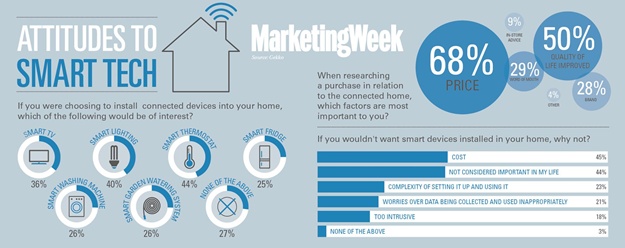
Among the appliances available, the smart thermostat is the most popular with 44 per cent of people saying they would consider installing one in their home. Smart lighting comes second (40 per cent) followed by smart TV (36 per cent).
which_connected_devices_are_of_interes_460
But 27 per cent would not consider installing a connected appliance, with 45 per cent citing cost as their top concern. When asked to specify an additional amount they would be willing to spend on such an appliance, the majority select zero.

Thirty per cent of people are willing to spend an extra £100 on a smart fridge that enables users to keep track of their food stocks via a mobile device. The majority (55 per cent), however, are unwilling to pay a premium for such an appliance.

Daniel Todaro, group managing director of Gekko, believes the concept of the connected home “has moved beyond the early adopter stage and started to trickle into the mainstream”. But given that many people remain unsure about smart appliances, brands must educate the public about the benefits of the technology, he says, adding: “Once people recognise the opportunities to save money, it will become more accessible.”

Todaro suggests that as the weather turns colder in the coming months and energy bills rise again, utility brands will devote more resources to marketing smart meters that enable people to control their heating remotely. In January, for example, British Gas ran a nationwide advertising campaign to promote its smartphone-controlled central heating system Hive .

According to the research, 50 per cent of people regard the impact on their quality of life as a key reason for buying a connected appliance, compared with just 28 per cent who care about the brand behind the product. Word of mouth matters to 30 per cent of respondents while 9 per cent regard in-store advice as an important factor.

what_factors_are_most_important_when_purchasing_a_smart_home_devic_460
Electronics retailers Currys and PC World are rolling out ‘smart technology areas’ across their stores to help educate consumers and enable them to interact with connected appliances. The companies are owned by parent group Dixons Carphone, which this month completed a £3.8bn merger that aims to put it at the forefront of the internet of things .

“We’re also investing in training our store colleagues on smart technology and launching online microsites for customers, which are dedicated to smart technologies such as connected home devices to help educate and inspire,” says Dave Ward, head of new technology and innovation at Currys and PC World. While the cost of installing smart appliances is relatively high, Ward claims prices are beginning to come down as the technology matures.

“We also think many of these technologies have the ability to save real money,” he adds. “Early adopters may pay a little more to be at the forefront but they will soon save money [on energy consumption] through devices such as smart thermostats and lights.”

In addition to the cost issue, 21 per cent of survey respondents express concern about how brands use personal data gathered from smart appliances. Eighteen per cent say the technology is ‘too intrusive’ while 23 per cent are concerned about the complexity of setting up the appliances.

Technology companies such as US firm Revolv have sought to simplify the connected home by creating a single hub through which all smart appliances are controlled. Revolv provides a router that receives signals from other companies’ appliances and a single app that allows users to co-ordinate all their home technology from their smartphone or tablet.

Last month the company launched an Android app to sit alongside its existing iOS offer and announced its integration with Google’s Nest thermostat. “Our brand promise is to unify off-the-shelf devices made by many manufacturers regardless of the protocol within those devices,” says Suttida Yang, director of marketing at Revolv.

With regard to the data issue the company is keen to ensure a strong value exchange with users. “We believe consumer data and privacy are owned by the consumer; there’s always a trade-off and convenience that we can provide when the consumer allows us to access that data,” says Yang. “To that end, we take privacy and security very seriously such that the communications between our app, hub and cloud are all encrypted and anonymised.”

The entrance of the world’s biggest tech companies into the smart home market is likely to reassure consumers and accelerate adoption. In June, for example, Apple unveiled HomeKit , a suite of tools for controlling home appliances. Apple is working with brands such as Honeywell, Philips and Broadcom to develop the platform.

why_do_you_not_want_smart_home_devices_in_your_hom_460
The $3.2bn (£1.9bn) acquisition of Nest in January demonstrates Google’s determination to be a dominant presence in the connected home too. Nest intuitively adjusts its settings according to people’s usage patterns, such as reducing the thermostat temperature setting when it senses nobody is home.

But despite excitement around these products, the role of connected devices depends also on government policy towards super-fast broadband. Last week, the UK Government said its plan to provide super-fast broadband to 95 per cent of homes and businesses by 2017 was “firmly on track” after announcing that one million homes and businesses have access already.

However, business lobbyists and commentators have criticised the Government for a lack of ambition, claiming that its definition of ‘super-fast’ lags behind many other nations. Gekko’s Todaro agrees with this assessment and believes stronger Government action is needed to support the growth of the internet of things across the UK.

“The Government is woefully behind on super-fast broadband,” he says. “Most homes in the UK don’t yet have the necessary speed of broadband to have a connected home.

“We’re way behind the Nordics, for example, and a lot of other places in Europe. It needs to become part of our psyche as a nation if we want to continue moving forward.”

3029290_Attitudes_to_smart_home_technology_infographic

Read more at – http://www.marketingweek.co.uk/trends/trending-topics/sector-trends/smart-homes-lack-consumer-connection/4011378.article

Tagged , ,

The growing chasm between the number of new supermarkets and new employees

trolley

With most of the of country suffering through the recession, the big supermarkets continued their relentless growth, says Dan Todaro, managing director at Gekko. He writes:

All too often in this country it feels like every time a shop closes, every time a building is demolished and with every new urban development a new Tesco Metro or Sainsbury’s Local springs up. It can be good news for locals, bringing jobs to the area as well as the convenience of having a nearby supermarket. Yet there is a downside. In the race to not fall behind their competitors, the big five supermarkets – Tesco, Sainsbury’s, Asda, Morrisons and The Co-Op – are at risk of overlooking what should be the most important facet of their business. The customer.

Research we recently put together at Gekko highlights that the average number of stores amongst the big five supermarkets has increased by 11% in the last three years, yet the average number of staff has fallen by over 9%.

Streamlining

Tesco, with the largest market share of the big five, had 431 more stores in 2013 than they had in 2011, yet the number of employees didn’t rise proportionately. This might be, in part, owing to more effective streamlining of the customer journey and the implementation of efficient technologies to save supermarkets time and money. Yet the overall picture is one of massive expansion with modest increases in staff numbers and there’s a real risk that customers are being abandoned between walking in the door and leaving with their purchases.

The big supermarkets are playing a dangerous game by drawing an increasingly fine line between maximising profits with persistent expansion and ensuring the consumer experience is positive.

Expansion

It was recently announced that this expansion is slowing a little, with the amount of new supermarket space proposed for the UK falling to the lowest level since the financial crisis. However that’s still 15.22m square feet being proposed, with 2.47m square feet under construction.

It’s mind-boggling that in a country already filled with supermarkets, a space over forty times the size of St Paul’s Cathedral is currently being converted to this purpose. Nonetheless, the slowing growth of space gives the big grocery chains an opportunity to make sure their recruitment levels catch up with the number of stores recently opened.

Human touch

If you’re looking for a certain product in a supermarket or need to know which products are included in a deal, you still need a member of staff rather than Google or an app. The human touch still plays a huge role in-store.

It isn’t just that supermarkets need to hire more staff, they also need to invest in providing them with the appropriate training to be a real selling point for the company. Great staff can make the difference between a consumer buying or not buying a product; between a consumer buying one item or five items. Most importantly, they can make the difference between whether they choose to come back to the store again and again, or go elsewhere.

The best-loved brands ensure their stores are filled with highly trained, helpful staff. And big supermarkets need to learn from this approach.

Customer service

The big chains also need to recognise that consumers respond to great customer service and that often requires having sufficient staff to deal with enquiries and help with any problems. We’ve all stood around waiting for help to arrive when the self-service checkout is having an off day. It can take an age for someone to be free to come and help. It’s enough to turn consumers off.

Given the competition that exists between the big supermarkets, they can’t afford for consumers to start voting with their feet after yet another delay to buy their shopping. Major grocery chains have to ensure that they maintain standards in-store by matching their investment in expansion with a proportionate investment in staff. Otherwise they risk driving consumers elsewhere.

Indeed, one of the reasons some people prefer to shop with independent retailers is for the personal touch and knowledge of products that you can often struggle to find in many major retailers.

Staff investment

Tesco might have the biggest market share, but in a Which? consumer survey last year it was voted the least popular supermarket. By contrast, Waitrose – which operates with investment in staff seemingly at the centre of what they do – came top.

Given Tesco’s recent fall in profits, maybe it’s time to invest in more well-trained staff, instead of seemingly infinite store expansion. In what is arguably one of the most dynamic industries which is constantly reinventing itself to meet the needs of consumers, staff is a critical factor to success.

The big supermarkets must invest properly in staff or risk losing customers.

Read the full article at http://www.talkingretail.com/opinion/talkingpoints/growing-chasm-number-new-supermarkets-new-employees/

Wearable tech would benefit from an haute couture approach

glass fashion banner

Figures from CCS Insight suggest that sales of smart wearable devices are going to rocket from 9.7m last year to 135m in 2018. This is predicted to include 68m smart watches and 50m smart bands. It’s not beyond the realms of possibility that the figures will prove accurate, though the claims don’t seem especially well-supported as there’s a lot that has to change between now and then if this massive boost in smart wearables is going to happen.

Primarily, the creators of smart wearable tech need to ensure they’re actively catering to a key market when it comes to setting trends, the fashion industry.

Consumers who are not only willing but able to spend £2k, £5k or £10k on a watch or an item of jewellery are the trendsetting future of wearable tech. If the fashion industry, and women in particular, are offered a wide range of high-end wearable tech in a variety of styles to choose from, the trend might really take off with all and not just those interested in tech. Yet at present many of these devices are for some aesthetically unappealing. If a consumer is offered a beautiful smart watch from an established luxury brand like Tag Heaur, Omega, Rolex etc, which has the desirability of a traditional high-end watch but with the extra functionality of a smart device, then perhaps wearable tech has a chance of really catching on as indicated.

It’s not unimaginable that eventually these high-end brands and fashion groups like LVMH will start having greater involvement in hardware, and not just the casing and accessories of smart tech. A Tiffany smart bracelet isn’t as far-fetched an idea as it might first seem. Once we reach a point where there’s a range of quality smart products to wear and match with what we’re wearing, how we’re feeling, or what we’re doing that day, then consumers will really get behind the idea. One day in the not too distant future it might be that someone going for a run puts on their hardy GPS smart wristband, before changing to go to a gig and putting on their more stylish smart watch. The possibilities of wearable tech are endless, but until the technology is more widely adopted by consumers, the tech giants and brands aren’t going to feel confident enough to invest in it.

Ultimately it may well take a greater push by Google with its Google Glass or a brand leader like Fitbit to get us to the tipping point where wearable tech is the norm. There are voices in the industry saying it’ll never take off because of privacy concerns; we must remember similar arguments were made when the internet was opened to mass consumer use. This is no time to be technologically impotent. The fact remains that with the phenomenal potential of wearable tech, demonstrated by Google Glass, to make our day-to-day lives more efficient and enjoyable, it is the future. It might take two or three years to truly establish itself, but the moment when mainstream and luxury brands fashion brands get on board with it, we’ll know the age of wearable tech has truly arrived.


Read more at – http://wallblog.co.uk/2014/08/20/wearable-tech-would-benefit-from-an-haute-couture-approach/

Tagged , , ,

The do’s and don’ts of a second interview

interview banner

Second interviews are not always essential – I have made successful hires from first interviews, having identified and assessed the key traits and experience I wanted the candidate to demonstrate at the first stage.

However this is often not the case; despite utilising experienced interviewers who probe in all the right places, second interviews are an ideal opportunity to ensure you are hiring the right candidate to fulfil your role by assessing them further. There is also the added advantage of being able to set tasks to challenge the candidate, such as presentations or case studies if appropriate.

The opportunity of a second interview is one most candidates are delighted to have. At this stage, you believe you have a selection of the highest calibre of candidates in the market to choose from. Do not then make the mistake of forgetting you are there to impress too.

Ensure you are fully prepared by taking note of the following do’s and don’ts of a second-stage interview:

  • Do set expectations. Candidates should be made aware that they are not the only individual selected to attend this stage (if this is indeed the case). Some candidates wrongly assume they have made a sufficient impression and that they are a shoe in for the job. They need to be aware that there is competition, and will then try even harder to impress rather than acting overly confident.
  • Don’t have the second interview at the same time of day as the first. On occasions this may not be possible if a candidate is meeting you on their lunch break. However it is an ideal way of assessing the candidate’s behaviour at different times of the day.  If your second interview is at 9am, is the candidate as prepared as they were if the first interview was at 2pm?  Were they on time or stressed by the traffic or their commute? In addition, holding interviews at this time as well as a 4.30pm interview will allow the candidate to see what the commute will be like to and from work on a daily basis – is it as they thought it would be?
  • Do invite different interviewers to attend. These different people do not have to be a manager or a senior appointment, but colleagues in a similar role as you are interviewing for as they can give great insight, views and opinions. They can sometimes offer more accurate answer to questions the candidate may ask about the day-to-day duties of the role. It will also give the candidate the opportunity to see who they will be working with as part of the wider team.
  • Don’t forget it’s your turn to shine. Do not leave all the impressing to the candidate. At this stage, candidates are making their decision too, such as  ‘will I get on with this person as my line manager?’ and ‘is this role and this company where I see my next career move?’. You must pre-empt questions that the candidate may not address with you. Make sure you have discussed every necessary detail of the role as well as promoting yourself and the company.
  • Do repeat some questions. You don’t want to be sitting in front of the same candidate repeating yourself, yet if you ask the question at the beginning of the first interview, ‘why are you leaving your current role?’, and then ask the same question more casually at the end of the second interview, chances are there will be a different answer. At this stage you will have built a relationship with the candidate; they are more at ease and willing to share more with you than they did when you first met as strangers.
  • Don’t leave any stone unturned. Some of the most valuable time spent in a second interview is addressing any concerns you had after the first stage. Have your questions prepared to address these; if you are not in attendance yourself, share these reservations with colleagues who are. Each interviewer must have their own personal opinion of the candidate, however it is essential that they are aware of your feedback – be honest. If you don’t highlight a concern now at interview stage, three months later you may be re-recruiting.
  • Do show the candidate around the office if possible. Introducing them to the team is not always appropriate, but allowing them to see any facilities in the building that may be attractive or particularly beneficial to them (e.g. parking, canteen, games room) and a brief tour of the office they may be working in will help them feel more comfortable about deciding whether your company is right for them.

It’s decision time – don’t get to this point without being able to make one. Preparation, effective questioning, along with self and company promotion are key to a successful second interview and an accepted offer of employment.


Read more at: http://www.hrzone.com/feature/recruitment/dos-and-donts-second-interview/144077

Tagged ,

How to write a great job advert

Real-Business copy

A job advertisement, unless it’s for a well-known brand, is the first impression that candidates will get of your business. It is therefore crucial that your company’s advert makes a good impression at the start of the candidate journey.

The advert must attract quality talent and to do so it must paint an accurate picture of the role, specify the experience and traits you require from your future employee and entice the reader to apply by highlighting what sets your role apart from similar roles at other companies, in order to encourage candidates to make the next step.

The headline

When advertising a job online, consider the job title or simple headline that your intended candidate is likely to search for. This will maximise the chance of candidates finding your advert and attract higher levels of traffic.

The job title being used internally in your business might differ from how candidates would refer to it, or not commonly used in the wider industry. Without a relevant job title, your position might not be found by prospective candidates, or in the event that it is found, confused candidates may click away from the page. Ensure your advert can be found and will attract attention from the people you want.

Don’t recycle

If your recruitment campaign is based on an existing role the easy option is to re-use the last advert which may well have proven successful. Although tempting, the chances are the job and the industry will have evolved considerably. Instead, start from scratch to create a brand new job advertisement that is fresh and contemporary.

Who is writing the job advert?

Do not fully rely on your HR/Recruitment department to create a job advert. Although they can offer valuable guidance on what content will attract candidates, if they are not working in the role you are recruiting for they are only basing the core content on what they believe the role involves.

The prospective line manager should be involved in the creation of the advert, and any input from an employee currently in a similar role will be extremely valuable. This added input will ensure that the advert accurately describes what the role involves.

Build interest

Before you finalise your job advert, consider the reader experience. Your advert should not be an exhaustive list of tasks the role involves; instead, make it an overview of the role itself. It is important to avoid listing too many requirements as candidates who may not tick everything on that list may not apply, meaning you may lose an otherwise perfect candidate.

The advert must engage and excite candidates whilst reflecting company and brand values – ask a number of different people in the business to read it and gather opinions and feedback.

Detail the salary and package

Include a salary bracket in order to attract the right level of candidate for your business. By not specifying salary, you are potentially wasting time reviewing applications from candidates of all levels. Save your time – and theirs – by setting the expectation at this stage.

Don’t forget to detail added benefits that may entice candidates to apply: is there a bonus, car allowance, gym membership, or free parking? Let the reader know by detailing added extras – each candidate is motivated by different benefits.

This is the start of the recruitment lifecycle; getting the initial job advert wrong will prevent a successful and smooth running recruitment process. Follow these steps to create the best possible job advertisement to represent the role and your business.


Read more at: http://realbusiness.co.uk/article/27426-how-to-write-a-great-job-advert

Tagged ,

How to make the most of the induction process for new employees

growth business banner

Sarah Mandeville, recruitment manager at Gekko, gives her tips on what must be done early on to ensure new staff are welcomed and then retained.

The induction process is the first step in the right direction to staff retention. Your recruitment team and hiring managers are likely to have invested much time, effort and cost to ensure a talented individual has been selected to join the company, and it is therefore imperative that the initial welcome and induction is productive to ensure a successful hire.

Each new employee should be treated as an individual, not a number: create a detailed, tailored induction plan and make your new starter feels welcome and part of the team from day one.

 
Planning
Dedicated time should be spent in planning an induction in advance of an individual starting. When planning, involve anyone who may have had a relationship with this person at interview stage, as well as colleagues they will be working with long term.

Identify what needs to be covered, prioritise, and ensure anyone taking part knows what they need to discuss so as not to repeat information. Create an introduction folder or something similar containing any essential documentation they are likely to need, not only in the first few weeks but on an on-going basis.

 
First impressions count
Yes, this person has accepted an offer to join your company, however mistakes in the early days could prevent them from staying. Go back to the very basics from how to answer the phone and transfer a call, to where to find the toilets and water coolers.

These minor details often get forgotten; make people feel comfortable in the building so they don’t just feel like a visitor. Ensure their desks and equipment have all been set up, and if being re-used are they in good working order and most importantly clean?

 
Adapt your plan along the way if required
Having spent time with a new employee, you will get to understand their learning styles. After the first couple of days, review the induction to see if any changes need to be made and if so perhaps moretailored to their needs.

Something you may have planned to take three hours may only take half that time if the person picks it up quicker. Likewise they may need to focus more attention on other areas, and therefore you must adapt as necessary.

 
Prepare existing staff
Inform colleagues (not just the immediate team they are working in) that there is a new starter so they can all make them feel welcome. Give existing employees an introduction to the new team member before they start, helping relationships develop more quickly. Ensure colleagues who are inducting have dedicated the time to do so in their current work schedules and are able give the new starter their undivided attention.

 
Don’t overwhelm
Aspects of the role or company that are essential for the employee to know may not be necessary to discuss in the first couple of weeks; can it wait until a person is settled? Sitting through presentations with departments they won’t have any involvement in for a few months are not necessary in the initial induction period and may well be forgotten by the time it is relevant.  Reschedule for a later date when the employee is settled.

 
Allow for reflection time and review
An induction can consist of so much information meaning it can be counterproductive if there is no time to allow the person to take it all in. Allow some time every day for them to review what they have been taught, and inform them of what they can do in any other spare time as and when the opportunity presents itself.

Introduce documents they can revise in this down time, show them where they can look on the intranet or how to find and review case studies etc. At the end of the induction programme invite the employee to review the induction with their line manager. Allow this to be in an informal setting so the employee can feel comfortable in being honest, and so any concerns or plans for action can be addressed from either side.

A new starter satisfied with their first few weeks in the role will lead to a long term employer/employee relationship. This all starts with the induction: it is important that the new recruit does not get lost in the business of our day today roles – give them your full attention and make them a success.

Tagged , , ,

How London businesses can hang on to their world class workforce

london skyline banner

As someone who runs my own business, there are two bits of research that have caught my eye in the past few weeks. Individually, neither is particularly dramatic, but when combined they represent a real challenge for London businesses.

 
The first is the latest report from High Fliers confirming that the median starting salary for top graduates has stuck at the same level since 2010. From 2004 until then, it grew roughly in proportion to the growing cost-of-living. Yet owing to the downturn the figure has stagnated four years in a row.

The second stat – which should make some businesses nervous – is that rental prices in London have increased to such an extent that the average London rent (£1,348/month) is now more than twice the average rent in the North East (£520/month). It’s a worrying situation when the brightest young talent are being offered a diminishing quality of life if they choose to work in London.

It only takes a quick check of any jobsite to see that there are some great companies offering competitive salaries for jobs in the North East. It isn’t sustainable for businesses to continue to assume the brightest young grads will keep throwing away so much of their income on London rent, when they could be living the high life away from the capital. Businesses need to give their employees the confidence and security they need to stay.

One of the many reasons some of the brightest workers are attracted to London is because of its innovation and creativity. Yet employers need to ensure they’re applying this innovation and creativity to how they motivate and retain their staff. It’s great to offer pension schemes, life insurance and gym membership as enticements to your staff where many other businesses still don’t.

However, to attract the best workers, businesses need to make it feasible for their employees to remain in London and not lose them to more affordable areas. Living in London is a delicate balance, and there are two main ways that businesses can help their employees

 
1. Lend employees their rental deposits

Even the cheapest shared accommodation in London can reach £650-700/month, and landlords often demand a deposit of six to eight weeks rent. This means that companies hoping to hire the brightest and best graduates fresh out of university are expecting them to have nearly £1,500 in the bank. Companies should therefore soften the blow of their employees moving to the city by loaning them their deposit, to be repaid over the course of their first two years. There’s little risk to the company, as the amount would be roughly a month’s salary, which can be withheld if anything goes wrong and the employment is terminated. Such an offer would help to entice the best candidates to apply, and demonstrate the value you place in supporting your workforce. Companies who can’t afford to pay all the deposit up front for their employees can still make a loan contribution. With London prices so high, every little helps.

 
2. Subsidise their ‘me’ time

It isn’t just having somewhere to live that’s so expensive in London, day-to-day living adds up too. With a strong work-hard play-hard ethic, many Londoners need to find the time to relax, or risk burning out. It’s in everyone’s interests for employers to get involved in this. Many firms already subsidise or pay for gym membership. Yet to go one step further, it’s crucial that employees take time out to recover, reset and recharge. Companies who contribute to their employees wellbeing with a leisure allowance – a contribution that might go towards tickets for the theatre, football or a new art exhibition – can reap the rewards of a de-stressed and re-motivated staff whose minds are open to new forms of creativity. Immersing staff into the wealth of cultural activities the greatest city in the world has to offer enriches your workforce and its ideas: that’s the creative spirit that makes London great.

If the cost of living in London continues its rise, there’s no doubt that salary is going to become an increasingly vital criteria for job applicants. Companies who can’t compete with larger companies on salary have to be inventive and stand out with what they can offer employees. There aren’t metrics to gauge the benefits to a company of having motivated staff, but it should be high on the priority list for any business. If businesses can offer prospective employees the benefits of London life without the drawbacks, London should retain and continue to attract its world class talent.


Read more at: http://realbusiness.co.uk/article/27200-how-london-businesses-can-hang-on-to-their-world-class-workforce

Tagged ,

How to give the perfect interview – and bag the perfect candidate

londonlovesbusinessSourcing the right people and attracting talent to roles is a major challenge for any recruitment department. Here’s how to do it

Making your opportunity stand out among the thousands out there is vital. And once that CV reaches you – revealing the ‘perfect’ candidate on paper – it’s down to he or she only to deliver at interview, do the research, dress to impress and nail that presentation, right?

Wrong. You should be fully prepared to judge how this individual is right for your team, business and clients – and make the right decision to hire.

1. It’s in the meet and greet

First impressions count. The handshake, the smile and the overall presence – but remember to pay attention to the less obvious details too, what people say about shoes is true!  Candidates are given the chance to prove themselves throughout the time you spend with them, but ultimately it comes down to whether you would put that person in front of your MD, clients and customers presented as they are at their best – the interview.
2. Stop when you’ve seen enough

A short interview isn’t always a bad interview. Interviewers often make the mistake of clock watching, trying to make sure they fill that one hour session. Don’t do it, just stop when you’ve seen enough! Don’t waste your time or theirs if you’ve made the decision and it’s not going to work. And if they demonstrate the skills you’re looking for in a short space of time, be careful not to fill time by asking irrelevant questions and going off track as this could put candidates off.
3. Address the clichés, numbers, hobbies and interests

That opening paragraph on a CV can read like a long list of carefully selected adjectives, while the key achievements sound incredible. Break those words and numbers down: “UK’s top sales professional”, out of how many people? “Grown sales 51% since last quarter”, how exactly has this been done? More specifics please. Hobbies and interests are important to the cultural fit, but remember to explore them further, ensure the candidate hasn’t exaggerated by going into the finer detail.  If they “love playing golf”, what is their handicap? And if they haven’t put any interests down, ask. You’ll appeal on a more personal level that way, which is particularly important when remembering the below…
4. You are there to impress too

Don’t let your hiring manager run to an interview, grabbing a CV off the printer on the way, not briefed by the person who selected the candidate to interview. You need to sell not only the company, role and work culture, but also sell yourself as their line manager or direct report. Inform them of your background and let them know what they can learn from you personally. What can you offer them that other employers can’t? Tell them about the workplace culture and practices whether – it be complementary breakfast, flexi time, monthly company days out or free parking.  Share, you’ll be surprised what motivates people when it comes down to deciding what opportunity is best for them to take.
5. Does your interviewer know what they are doing?

When you’ve recruited a new manager or promoted within, training on interview skills are often forgotten. It may not be a priority at the time, but within days of requesting to recruit, your hiring manager could be sitting across the table from a potential future employee with no idea where to start. Introduce recruitment training sessions as an ongoing programme – don’t lose that great hire through a poor interview and lack of preparation on your part.


Read more at: http://www.londonlovesbusiness.com/business-news/business/how-to-give-the-perfect-interview-and-bag-the-perfect-candidate-/8482.article

Tagged , , ,